AAAAA () is awarded to the most important and best-maintained tourist attractions in the People's Republic of China, given the highest level in the rating categories used by the Ministry of Culture and Tourism. As of 2025, there are 359 tourist attractions listed as 5A.[1]
History
The origins of the rating system for tourist attractions are based on criteria first set out in 1999 by the China National Tourism Administration (predecessor to the current Ministry of Culture and Tourism) and revised in 2004.[2] The criteria include quality and management factors like ease of transportation links, site safety, cleanliness, etc., and also takes into account the uniqueness and recognition of the sightseeing offers.[2] Tourist attractions were graded according to the criteria on a scale initially from A to AAAA with AAAAA or 5As added on later as the highest rating. A group of 66 tourist attractions was certified as the first set of AAAAA rated tourist attractions in 2007.[2] The first batch included many of the most iconic historical sites in China including the Forbidden City and Summer Palace. Additional batches of additional sites have been added including 20 new 5A sites in February 2017.[3] On rare occasions, a few locations have been downgraded from the highest rating category for deficiencies in visitor experience.[4]
List
Beijing
| Prefecture | Name | Date of inclusion | Description | Image |
|---|---|---|---|---|
| Beijing | Forbidden City ("Palace Museum") | 2007 | A .72 km2 compound of 980 buildings,[5] initially constructed by the Yongle Emperor from 1406 to 1420,[6] used as the main palace of the Ming and early Qing dynasties, converted into a public museum in 1925.[7] Its southern Gate of Heavenly Peace (Tian'anmen) displays a famous portrait of Mao Zedong and has been the scene of numerous important events in modern Chinese history, including the 1 October 1949 celebration of the founding of the PRC and the Tian'anmen Square protests of 1989. | |
| Beijing | Temple of Heaven | 2007 | A 2.73 km2 compound of 92 buildings,[8] initially constructed by the Yongle Emperor in 1420,[8][9] used for the traditional worship of Heaven during the Ming and Qing dynasties, converted into a public park in 1918.[9] | |
| Beijing | Summer Palace | 2007 | A 2.97 km2 compound surrounding Longevity Hill and Kunming Lake,[10] initially constructed by the Qianlong Emperor from 1750 to 1764[10] to represent other famous sites of China and Chinese mythology in miniature, used as the unofficial main palace for the rest of the Qing,[11] infamously[12] razed by European troops in 1860 during the Second Opium War, rebuilt by the empress dowager Cixi and a center of late Qing government, damaged and looted by foreigners again in 1900 during the Boxer Rebellion, converted into a public park in 1924,[10] and extensively restored since 1953. | |
| Beijing | Badaling and Mutianyu Great Wall | 2007 | A 3,741 m section of the Great Wall[13] initially constructed in 1505 to protect the Juyong Pass,[14] restored after 1952,[15] and opened to tourists in 1958.[13] It has received scores of foreign leaders, most notably US president Richard Nixon during his 1972 visit.[15] | |
| Beijing | 13 Ming Tombs[16] | 2011 | A 34.35 km2 necropolis[17] constructed between 1409 and 1644 at the foot of Tianshou Mountain, used as the resting place for 13 of the 16 emperors of the Ming.[16] | |
| Beijing | Prince Gong Mansion ("Prince Kung's Mansion")[18] | 2012 | A 6 ha (15 acre) compound with an expansive garden,[18] initially constructed in 1777[19] by the Qianlong Emperor's notoriously corrupt[20] official Heshen, used as a residence for members of the imperial family including the diplomat Yixin during the rest of the Qing,[18] repurposed as the women's campus of Fu-Jen Catholic University under the Republic and as residences for leaders of the Ministry of Public Security under the People's Republic,[11] restored after 1982,[18] and opened as a museum in 1996.[21] It is one of the few surviving Qing palaces, out of the 74 still used by imperial princes at the fall of the empire.[11] | |
| Beijing | Olympic Green | 2012 | An 11.59 km2[22] Olympic Park constructed for the 2008 summer games, now featuring the Bird's Nest stadium, the National Indoor Stadium, the Water Cube aquatics center, the Olympic Forest Park, and national science & technology and the ethnic museums. | |
| Beijing | Old Summer Palace | 2020 | An 8 kilometres (5.0 mi) northwest of the walls of the former Imperial City section of Beijing. Constructed throughout the 18th and early 19th centuries, the Old Summer Palace was the main imperial residence of Qianlong Emperor of the Qing dynasty and his successors, and where they handled state affairs; the Forbidden City was used for formal ceremonies. Widely perceived as the pinnacle work of Chinese imperial garden and palace design, the Old Summer Palace was known for its extensive collection of gardens, its building architecture and numerous art and historical treasures. It was reputed as the "Garden of Gardens" (traditional Chinese: 萬園之園; simplified Chinese: 万园之园; pinyin: wàn yuán zhī yuán) in its heyday. | |
| Beijing | Grand Canal Cultural Tourism Scenic Area | 2024 |
Tianjin
| Prefecture | Name | Date of inclusion | Description | Image |
|---|---|---|---|---|
| Tianjin | Guwenhua Jie ("Ancient Culture Street") | 2007 | A 560 m[23] street lined with imitation Qing shops opened in 1986,[24] selling traditional wares and snacks[23][25] beside Mazu and Taoist temples (originally dating to 1326 and 1368, respectively)[24] and a folklore museum.[26] | |
| Tianjin | Mount Pan ("Panshan Scenic Area") | 2007 | A 105 km2 forest park surrounding 850 m Mount Pan,[26] whose temples were first built in AD 25 during the Han. The four surviving temples include a 13-story dagoba and have all been renovated since the 1990s.[26] |
Hebei
| Prefecture | Name | Date of inclusion | Description | Image |
|---|---|---|---|---|
| Qinhuangdao | Shanhai Pass ("Shanhaiguan Scenic Area") | 2007 | A cluster of fortifications which once guarded the 10 km Shanhai Pass between Horn Mountain in the Yan chain and the Bohai Gulf,[27] protecting "China Proper" from Manchuria, initially constructed in 583[28][29] during the early Sui dynasty and taking most of its present form from Xu Da's work in 1381 during the early Ming, when it became the eastern end of the Great Wall.[27] Its strategic importance made it the site of numerous major events,[29] most famously the 1644 battle that directly led to the establishment of the Qing.[30] | |
| Baoding | Baiyang Lake ("Lake Baiyandian") | 2007 | The largest lake in northern China, although growing urban and agricultural water use after 1950 reduced its size from more than 1000 km2 to almost nothing in the 1980s.[31][32] It is presently composed of 143 smaller lakes around 366 km2 and is used for nature tourism,[33] but its size is now maintained by unsustainable use of highly polluted groundwater.[31][34] | |
| Chengde | Chengde Mountain Resort ("Imperial Summer Resort and the Surrounding Temples") | 2007 | A 6.1 km2[35] compound initially constructed from 1703 to 1792 during the Qing,[35] with an imperial summer resort surrounded by areas of mountains, plains, and lakeshore mimicking China's overall topography,[36] serving as a culmination of traditional Chinese gardening and an influence on landscape gardening worldwide.[35] The palace was a particular favorite of the Kangxi and Qianlong emperors, and its intermixed ethnic architectural styles consciously affirmed their government's commitment to a multicultural state, and it.[35] | |
| Baoding | Yesanpo National Park | 2011 | A 334.8 km2[37] park at the intersection of the Taihang and Yan chains,[37] comprising three main scenic areas—the Baili Gorge, the Longmentian Pass, and Fodongta Peak with Yugu Cave.[37] | |
| Shijiazhuang | Xibaipo | 2011 | A village including a museum and other memorials reconstructing its role as the headquarters of the Chinese Communist Party and People's Liberation Army in late 1948 and early 1949, an important period of the Chinese Civil War.[38] (The original sites are underwater as a result of local hydroelectric projects.)[39] | |
| Tangshan | Eastern Qing Tombs | 2015 | A 78 km2[40] necropolis of 508 buildings constructed between 1661 and 1908[41] in a hollow of Changrui Mountain,[42] used as the resting place of 5 emperors of the Qing,[42] as well as the dowager empress Cixi.[43] | |
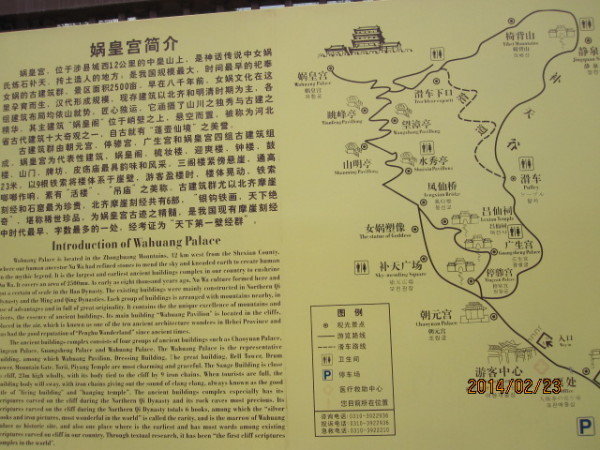
| Handan | Nüwa Imperial Palace ("Wahuang Palace")[44] | 2015 | A 1.7 km2[44] compound beside Phoenix Mountain (Fenghuangshan)[45] honoring the goddess Nüwa,[44] who temples were first built under the Han.[44] The surviving palaces and temples were initially constructed under the Wanli Emperor of the Ming,[45] were restored in the 1990s, and include one of China's most impressive rock carvings: 130,000 characters of Buddhist scripture engraved into the mountains from the Northern Qi onward.[44][46] | |
| Handan | Guangfu Ancient City | 2017 | A 1.5 km2[47] town in the center of Yongnian Marsh,[47] first settled during the Spring and Autumn period[48] and serving as the capital of Dou Jiande's and Liu Heita's short-lived principalities of "Xia"[47] and "Handong"[49] during the late Sui, with city walls initially constructed under the Tang and modern construction mimicking the town's appearance under the Ming.[50] It has museums to locals Yang Luchan and Wu Yuxiang, the founders of the two largest schools of tai chi.[47][51] | |
| Baoding | Mount Baishi ("Whitestone Mountain Scenic Area")[52] | 2017 | A forest park surrounding 2096 m Mount Baishi, the northern end of the Taihang Mountains[52] and site of the 1937 Battle of the Great Wall during the 2nd Sino-Japanese War. | |
| Baoding | Western Qing tombs | 2020 | ||
| Chengde | Jinshanling Great Wall | 2020 | ||
| Tangshan | Nanhu Kailuan Scenic Area | 2024 | ||
| Hengshui | Hengshui Lake | 2024 |
Shanxi
| Prefecture | Name | Date of inclusion | Description | Image |
|---|---|---|---|---|
| Datong | Yungang Grottoes | 2007 | An 8.5 km2[53] area of 252 caves in the Wuzhou Mountains with 51,000 niches filled with Buddhist statues and 18,000 m2 of carved wall space,[54] initially constructed under the Northern Wei in the 5th & 6th century,[55] expanded by the Liao in the 11th,[56] and restored since 1952.[57] There is also a ruined Ming fortress and beacon tower over the caves.[58] | |
| Xinzhou | Mount Wutai | 2007 | A 423.12 km2[59] area surrounding the five peaks of Mount Wutai (3,061 m), considered holy since at least the Han (1st century AD), the site of imperial pilgrimage since the Northern Wei (5th century),[59] and the seat of the Buddhist bodhisattva Manjushri (Wenshu) since the 7th century,[60] and now hosting 53 monasteries in architecture spanning over a thousand years, including a timber hall from the Tang.[59] | |
| Jincheng | House of the Huangcheng Chancellor | 2011 | A 10 ha[61] (25 acre) walled estate with 9 gates, 19 gardens, and 640 rooms, initially constructed in 1633 for Chen Changyan and expanded in 1703 for Chen Tingjing, tutor to the Kangxi Emperor and chief editor of the Kangxi Dictionary.[62] | |
| Jinzhong | Mount Mian[63] | 2013 | A 75 km2 area[64] surrounding the peak of Mt Mian (2,440 m),[63] considered holy since at least the Spring and Autumn period (8th–5th centuries BC),[65] most famed as the scene of Jie Zhitui's supposed immolation by Duke Chong'er of Jin c. 636 BC[64] and thus the home of China's Cold Food and Tomb-Sweeping Festivals,[66] the site of imperial pilgrimage since the Tang (7th century),[64] when Li Shimin won an important victory nearby[65] and constructed a temple for the Princess Changzhao to retire to as a Buddhist nun.[64] | |
| Jinzhong | Pingyao ("Pingyao Ancient City")[67] | 2015 | A 2.25 km2[68] walled town of about 4000 buildings[69] in central Shanxi, first protected by earthen ramparts c. 800 BC,[68] thoroughly reconstructed and fortified c. 1370 under the early Ming,[68] serving as the financial center of the region from the 16th century and of the entire Qing Empire during the late 19th century.[68] The town exemplifies Ming & Qing urban planning, with over a hundred streets and lanes lined with 17th–19th century shops criss-crossing the town.[68] Organized restorations have been undertaken periodically since the 15th century, the most recent phase beginning in 1979.[68] The World Heritage Site also includes the nearby Shuanglin and Zhenguo Temples.[69] | |
| Xinzhou | Yanmen Pass Scenic Area[70] | 2017 | A cluster of fortifications which once guarded the 1 km Yanmen Pass beside Mt Gouzhu,[71] protecting "China Proper" from the nomads of the Eurasian steppe, initially constructed around 306 BC during the Warring States period[72] and taking most of its present form from Lu Ting's work in 1374 during the early Ming,[71] when it formed part of the "inner" line of the Great Wall.[72] Its strategic importance made it the site of numerous major events, most famously the 980 battle which formed an important element in the Chinese legends, plays, &c. about Yang Ye and the other Generals of the Yang Family.[73] | |
| Linfen | Locust tree of Hongdong Scenic Area | 2018 | ||
| Changzhi | Huguan Taihang Grand Canyon and Baquan Gorge | 2020 | ||
| Linfen | Mount Yunqiu | 2020 | ||
| Linfen | Hukou Waterfall | 2022 | ||
| Taiyuan | Jinci and Mount Tianlong | 2024 |
Inner Mongolia
| Prefecture | Name | Date of inclusion | Description | Image |
|---|---|---|---|---|
| Ordos | Xiangshawan | 2011 | Desert resort | |
| Ordos | Mausoleum of Genghis Khan | 2011 | A 225 km2[74] area surrounding a compound of 4 buildings[74] constructed between 1954 and 1956[75][76] to house relics used in the veneration of Genghis Khan, Tolui, and their wives since the Yuan, repurposed as a salt depot in 1968,[77] restored in the early 1980s,[75] and now the world center of Genghis Khan's cult,[77] despite having only replicas[78] after its desecration during the Cultural Revolution.[75] The site also includes an expansive prairie, an equestrian sports center, a hot air balloon area, and a village showcasing traditional Mongolian culture.[79] | |
| Hulunbuir | Manzhouli China-Russia Border Tourist Area | 2016[80] | The area includes the Matryoshka Resort, a cultural resort with a matryoshka theme, and National Gate Resort, a huge border gate with an observation deck at the top for visitors to overlook the border area between China and Russia. Other attractions at the scenic area include the No 41 Border Monument, Locomotive Square and the historical site of the 6th National Congress of the Chinese Communist Party held in 1928.[80] | |
| Hinggan League | Mount Arxan and Chaihe River scenic area[81] | 2017 | An amalgam of the Arxan National Forest Park and Geopark, the Zhalantun Scenic Area, and Rose Peak.[81] | |
| Chifeng | Ashatu Stone Formation | 2018 | ||
| Alxa League | Populus euphratica Tourist Area | 2020 | ||
| Hulunbuir | Hulunbuir Grassland and Morgele River Scenic Area | 2024 | ||
| Hohhot | Laoniuwan Yellow River Canyon Scenic Area | 2024 |
Liaoning
| Prefecture | Name | Date of inclusion | Description | Image |
|---|---|---|---|---|
| Shenyang | Shenyang Botanical Garden | 2007 | ||
| Dalian | Tiger Beach Ocean Park | 2007 | ||
| Dalian | Golden Pebble Beach | 2011 | ||
| Benxi | Benxi Shuidong National Park | 2015 | Benxi Water Caves | |
| Anshan | Qianshan National Park | 2017 | ||
| Panjin | Red Beach Scenic Area | 2020 | ||
| Benxi | Wunü Mountain | 2024 |
Jilin
Heilongjiang
| Prefecture | Name | Date of inclusion | Description | Image |
|---|---|---|---|---|
| Harbin | Sun Island | 2007 | One of the main exhibition areas for ice sculptures during the Harbin International Ice and Snow Sculpture Festival. | |
| Heihe | Wudalianchi | 2011 | ||
| Mudanjiang | Jingpo Lake | 2011 | Has received a serious warning from the Ministry of Culture and Tourism[citation needed] | |
| Yichun | Stone Forest Scenic Area | 2013 | Located within the Tanwanghe National Park. | |
| Daxing'anling | Arctic Village | 2015 | ||
| Jixi | Hutou Scenic Area | 2020 | ||
| Qiqihar | Zhalong Nature Reserve | 2024 |
Shanghai
| Prefecture | Name | Date of inclusion | Description | Image |
|---|---|---|---|---|
| Shanghai | Oriental Pearl TV Tower | 2007 | ||
| Shanghai | Shanghai Wild Animal Park ("Shanghai Wildlife Park") | 2007 | ||
| Shanghai | Shanghai Science & Technology Museum | 2010 | ||
| Shanghai | Sites of the National Congress of the Chinese Communist Party (1st, 2nd and 3rd) | 2021 | ||
| Shanghai | Xisha Pearl Lake Scenic Area | 2024 |
Jiangsu
| Prefecture | Name | Date of inclusion | Description | Image |
|---|---|---|---|---|
| Nanjing | Sun Yat-sen Mausoleum | 2007 | Located on Purple Mountain | |
| Wuxi | CCTV Wuxi Film/TV Studio | 2007 | ||
| Suzhou | Classical Gardens of Suzhou (Humble Administrator's Garden, Lingering Garden and Tiger Hill) | 2007 (Humble Administrator's Garden) 2010 (Lingering Garden and Tiger Hill) | ||
| Suzhou | Zhouzhuang | 2007 | Located on Kunshan | |
| Wuxi | Ling Shan Grand Buddha | 2010 | ||
| Nanjing | Fuzimiao and Qinhuai River | 2010 | ||
| Yangzhou | Slender West Lake | 2010 | ||
| Suzhou | Tongli | 2010 | ||
| Changzhou | Oriental Jurassic Park | 2010 | ||
| Taizhou | Qin Lake Scenic Area | 2012 | ||
| Suzhou | Jinji Lake | 2012 | Located in Suzhou Industrial Park | |
| Nantong | Hao River | 2012 | ||
| Zhenjiang | Three Mountains of Zhenjiang (Jinshan, Jiaoshan and Beigushan) | 2012 | ||
| Wuxi | Yuantouzhu | 2012 | ||
| Suzhou | Lake Tai | 2012 | ||
| Changzhou | Tianmu Lake | 2013 | ||
| Suzhou | Shajiabang and Yushan | 2013 | ||
| Zhenjiang | Mount Mao | 2014 | ||
| Huai'an | Former Residence of Zhou Enlai | 2015 | ||
| Yancheng | Dafeng Milu Nature Reserve | 2015 | ||
| Xuzhou | Yunlong Lake | 2016 | ||
| Lianyungang | Mount Huaguo | 2016 | ||
| Changzhou | Chunqiu Yancheng | 2017 | ||
| Wuxi | Hui Shan Ancient Town | 2020 | ||
| Lianyungang | Lian Island | 2024 |
Zhejiang
| Prefecture | Name | Date of inclusion | Description | Image |
|---|---|---|---|---|
| Hangzhou | West Lake | 2007 | ||
| Wenzhou | Yandang Mountains | 2007 | ||
| Zhoushan | Mount Putuo | 2007 | ||
| Hangzhou | Qiandao Lake | 2010 | ||
| Ningbo | Xikou-Tengtou scenic spot | 2010 | Located in Fenghua | |
| Jiaxing | Wuzhen | 2010 | ||
| Jinhua | Hengdian World Studios | 2010 | Located in Dongyang | |
| Jiaxing | South Lake | 2011 | ||
| Hangzhou | Xixi National Wetland Park | 2012 | ||
| Shaoxing | Lu Xun Native Place | 2012 | ||
| Quzhou | Root Palace Buddhist Cultural Tourism Zone | 2013 | Located in Kaihua County | |
| Huzhou | Nanxun Old Town | 2015 | Located in Nanxun District | |
| Taizhou | Tiantai Mountain | 2015 | ||
| Taizhou | Shenxianju | 2015 | Located in Xianju County | |
| Jiaxing | Xitang | 2017 | ||
| Quzhou | Mount Jianglang and Nianbadu | 2017 | ||
| Ningbo | Tianyi Ge and Moon Lake | 2018 | ||
| Lishui | Xiandu | 2020 | Located in Jinyun County | |
| Taizhou | Walled City of Taizhou Fu | 2022 | ||
| Lishui | Yunhe Terraces Scenic Area | 2024 | ||
| Jinhua | Shuanglong Scenic Area | 2024 |
Anhui
| Prefecture | Name | Date of inclusion | Description | Image |
|---|---|---|---|---|
| Huangshan | Huangshan ("Mount Huangshan Scenic Area") | 2007 | ||
| Chizhou | Mount Jiuhua | 2007 | ||
| Anqing | Mount Tianzhu | 2011 | Has received a serious warning from the Ministry of Culture and Tourism | |
| Huangshan | Xidi and Hongcun | 2011 | ||
| Lu'an | Tiantangzhai | 2012 | ||
| Xuancheng | Longchuan | 2012 | ||
| Fuyang | Bali River | 2013 | ||
| Huangshan | Huizhou Cultural Area | 2014 | ||
| Hefei | Sanhe Ancient Town | 2015 | ||
| Wuhu | Fantawild Adventure Wuhu | 2016 | ||
| Lu'an | Wanfo Lake | 2016 | ||
| Ma'anshan | Caishi Rock | 2020 | ||
| Chuzhou | Mount Langya | 2024 |
Fujian
| Prefecture | Name | Date of inclusion | Description | Image |
|---|---|---|---|---|
| Xiamen | Gulangyu | 2007 | ||
| Nanping | Wuyi Mountains ("Mount Wuyi") | 2007 | Has received a serious warning from the Ministry of Culture and Tourism | |
| Zhangzhou Longyan | Fujian Tulou | 2011 | Has received a serious warning from the Ministry of Culture and Tourism | |
| Sanming | Taining | 2011 | ||
| Ningde | Baishuiyang | 2012 | ||
| Quanzhou | Mount Qingyuan | 2012 | ||
| Ningde | Mount Taimu | 2013 | ||
| Fuzhou | Sanfang Qixiang | 2015 | ||
| Longyan | Gutian | 2015 | ||
| Putian | Meizhou Mazu Temple | 2020 | ||
| Xiamen | Xiamen Botanical Gardens | 2024 | ||
| Longyan | Mount Guanzhi | 2024 |
Jiangxi
| Prefecture | Name | Date of inclusion | Description | Image |
|---|---|---|---|---|
| Jiujiang | Mount Lu | 2007 | ||
| Ji'an | Jinggang Mountains | 2007 | ||
| Shangrao | Mount Sanqing | 2011 | ||
| Yingtan | Mount Longhu | 2012 | ||
| Shangrao | Jiangwan Village | 2013 | Located in Wuyuan County. | |
| Jingdezhen | Ancient Kiln Folk Customs Museum | 2013 | ||
| Yichun | Mingyue Mountain | 2015 | ||
| Ganzhou | Cradle of the People's Republic of China | 2015 | ||
| Fuzhou | Mount Dajue | 2017 | ||
| Shangrao | Guifeng Peak | 2017 | ||
| Nanchang | Pavilion of Prince Teng | 2018 | ||
| Pingxiang | Wugong Mountains | 2020 | ||
| Jiujiang | Mount Lu West Sea | 2020 | ||
| Ganzhou | Mount Sanbai | 2022 | ||
| Shangrao | Huangling | 2024 |
Shandong
| Prefecture | Name | Date of inclusion | Description | Image |
|---|---|---|---|---|
| Yantai | Penglai Pavilion | 2007 | ||
| Jining | Temple and Cemetery of Confucius and the Kong Family Mansion in Qufu | 2007 | ||
| Tai'an | Mount Tai | 2007 | ||
| Qingdao | Mount Lao | 2011 | ||
| Yantai | Mount Nanshan | 2011 | ||
| Weihai | Liugong Island | 2011 | ||
| Zaozhuang | Taierzhuang Ancient Town | 2013 | Located in Tai'erzhuang District. | |
| Jinan | Baotu Spring | 2013 | ||
| Linyi | Yimeng Mountain | 2014 | Located in Yishui County. | |
| Weifang | Qingzhou Ancient Town | 2017 | ||
| Weihai | Huaxiacheng | 2017 | Quarry complex turned into a scenic area and tourist attraction. Received more than 2.3 million tourists in 2018.[82] | |
| Dongying | Huanghekou | 2020 | ||
| Linyi | Firefly Water Cave and Underground Grand Canyon Tourist Area | 2020 | ||
| Jining | Weishan Lake | 2022 | ||
| Qingdao | Olympic Sailing Marine Cultural Tourism Zone | 2024 | ||
| Zibo | Zhoucun Ancient Commercial City | 2024 |
Henan
| Prefecture | Name | Date of inclusion | Description | Image |
|---|---|---|---|---|
| Zhengzhou | Mount Song and Shaolin Monastery | 2007 | ||
| Luoyang | Longmen Grottoes | 2007 | ||
| Jiaozuo | Yuntai Mountain | 2007 | ||
| Kaifeng | Qingming Riverside Landscape Garden | 2011 | Cultural theme park that recreates the painting Along the River During the Qingming Festival. | |
| Luoyang | Baiyun Mountain | 2011 | ||
| Anyang | Yinxu | 2011 | Site of the archaeological discovery of oracle bones and oracle bone script, which resulted in the identification of the earliest known Chinese writing. | |
| Pingdingshan | Mount Yao and Spring Temple Buddha | 2011 | ||
| Luoyang | Mount Laojun and Jiguan Cave | 2012 | ||
| Luoyang | Longtan Grand Canyon | 2013 | ||
| Nanyang | Laojieling and Xixia Dinosaur Relics Park | 2014 | ||
| Zhumadian | Mount Chaya | 2015 | ||
| Anyang | Red Flag Canal and Taihangshan Gorge | 2016 | ||
| Shangqiu | Mount Mangdang | 2017 | ||
| Xinxiang | Baligou Valley | 2020 | ||
| Xinyang | Mount Jigong | 2022 | ||
| Zhoukou | Taihao Fuxi Mausoleum Cultural Tourism Zone | 2024 | ||
| Zhoukou | Baoquan Tourism Area | 2024 |
Hubei
Hunan
| Prefecture | Name | Date of inclusion | Description | Image |
|---|---|---|---|---|
| Hengyang | Mount Heng | 2007 | ||
| Zhangjiajie | Wulingyuan and Tianmen Mountain | 2007 | ||
| Yueyang | Yueyang Tower and Junshan Island | 2011 | ||
| Xiangtan | Shaoshan | 2011 | ||
| Changsha | Yuelu Mountain and Orange Isle | 2012 | ||
| Changsha | Huaminglou Town | 2014 | ||
| Chenzhou | Dongjiang Lake | 2015 | ||
| Shaoyang | Mount Langshan | 2016 | ||
| Zhuzhou | Yandi Mausoleum | 2020 | ||
| Changde | Taohuayuan (Peach Garden) | 2020 | ||
| Xiangxi | Aizhai, Shibadong, Dehang Waterfall Tourist Area | 2021 | ||
| Xiangxi | Fenghuang Ancient Town Tourist Area | 2024 |
Guangdong
| Prefecture | Name | Date of inclusion | Description | Image |
|---|---|---|---|---|
| Guangzhou | Chimelong Tourist Resort | 2007 | ||
| Shenzhen | OCT | 2007 | ||
| Shenzhen | Mission Hills Resort | 2011 | ||
| Meizhou | Yannanfei Tea Fields | 2011 | ||
| Guangzhou | Baiyun Mountain | 2011 | ||
| Qingyuan | Lianzhou Underground River | 2011 | ||
| Shaoguan | Mount Danxia | 2012 | ||
| Foshan | Mount Xiqiao | 2013 | ||
| Foshan | Changlu Park | 2014 | ||
| Huizhou | Mount Luofu | 2014 | ||
| Yangjiang | Dajiao Bay Maritime Silk Road Park | 2015 | ||
| Zhongshan | Former Residence of Sun Yat-sen | 2016 | Located in Cuiheng Village, Nanlang Town | |
| Huizhou | Huizhou West Lake | 2018 | ||
| Zhaoqing | Xinghu | 2020 | ||
| Jiangmen | Kaiping Diaolou | 2020 | ||
| Heyuan | Wanlv Lake Scenic Area | 2024 |
Guangxi
| Prefecture | Name | Date of inclusion | Description | Image |
|---|---|---|---|---|
| Guilin | Li River | 2007 | ||
| Guilin | Merryland World | 2007 | ||
| Guilin | Jingjiang Princes' Palace | 2012 | ||
| Nanning | Mount Qingxiu | 2014 | ||
| Guilin | Two Rivers and Four Lakes Scenic Area | 2017 | ||
| Chongzuo | Detian Waterfall | 2018 | ||
| Baise | Memorial Park of Baise Uprising | 2019 | Site of the 1929–1931 Baise Uprising | |
| Beihai | Weizhou Island E'yu Mountain | 2020 | ||
| Hezhou | Huangyao Ancient Town | 2022 | ||
| Liuzhou | Chengyang Bazhai Scenic Area | 2024 | ||
| Chongzuo | Huashan Rock Art | 2024 |
Hainan
| Province | Prefecture | Name | Date of inclusion | Description | Image |
|---|---|---|---|---|---|
| Hainan | Sanya | Nanshan Buddhism Cultural Zone | 2007 | ||
| Hainan | Sanya | Nanshan Daxiaodongtian | 2007 | ||
| Hainan | Baoting | Yanoda Rainforest | 2012 | ||
| Hainan | Lingshui | Boundary Island | 2013 | ||
| Hainan | Baoting | Binglang Canyon Scenic Area | 2015 | ||
| Hainan | Sanya | Wuzhizhou Island | 2016 | ||
| Hainan | Sanya | Tianya Haijiao | 2024 |
Chongqing
| Prefecture | Name | Date of inclusion | Description | Image |
|---|---|---|---|---|
| Chongqing | Dazu Rock Carvings | 2007 | ||
| Chongqing | Small Three Gorges | 2007 | ||
| Chongqing | Wulong Karst | 2011 | ||
| Chongqing | Youyang Taohuayuan Scenic Area | 2012 | ||
| Chongqing | Black Valley Scenic Area | 2012 | ||
| Chongqing | Jinfo Mountain | 2013 | Jinfo Mountain is an isolated mountain with cliffs up to 300 m surrounding its relatively flat top, surrounded by forest. With its outstanding karst features and superb biodiversity, Jinfo Shan has been listed as a tentative World Heritage site since 2001. | |
| Chongqing | Simian Mountain | 2015 | ||
| Chongqing | Longgang Geological Park | 2017 | Longgang Geological Park is characterized by peculiar landforms such as karst, deep karst caves, grasslands and stalagmites. The world's longest cantilever bridge can also be found here. | |
| Chongqing | Ayi River | 2020 | ||
| Chongqing | Zhuoshui | 2020 | ||
| Chongqing | Baidicheng and Qutang Gorge | 2022 | ||
| Chongqing | Wuling Mountain Great Rift Valley Scenic Area | 2024 |
Sichuan
| Prefecture | Name | Date of inclusion | Description | Image |
|---|---|---|---|---|
| Chengdu | Mount Qingcheng and the Dujiangyan Irrigation System | 2007 | Construction of the Dujiangyan irrigation system began in the 3rd century B.C. This system still controls the waters of the Minjiang River and distributes it to the fertile farmland of the Chengdu plains. Mount Qingcheng was the birthplace of Taoism, which is celebrated in a series of ancient temples.[83] | |
| Leshan | Mount Emei | 2007 | The first Buddhist temple in China was built here in Sichuan Province in the 1st century A.D. in the beautiful surroundings of the summit Mount Emei. The addition of other temples turned the site into one of Buddhism's holiest sites. Over the centuries, the cultural treasures grew in number. Mount Emei is also notable for its exceptionally diverse vegetation, ranging from subtropical to subalpine pine forests. Some of the trees there are more than 1,000 years old.[84] | |
| Ngawa | Jiuzhaigou | 2007 | Stretching over 72,000 ha in the northern part of Sichuan Province, the jagged Jiuzhaigou valley reaches a height of more than 4,800 m, thus comprising a series of diverse forest ecosystems. Its superb landscapes are particularly interesting for their series of narrow conic karst land forms and spectacular waterfalls. Some 140 bird species also inhabit the valley, as well as a number of endangered plant and animal species, including the giant panda and the Sichuan takin.[85] | |
| Leshan | Leshan Giant Buddha | 2011 | The most remarkable is the Giant Buddha of Leshan, carved out of a hillside in the 8th century and looking down on the confluence of three rivers. At 71 m high, it is the largest Buddha in the world.[84] | |
| Ngawa | Huanglong | 2012 | Situated in the north-west of Sichaun Province, the Huanglong valley is made up of snow-capped peaks and the easternmost of all the Chinese glaciers. In addition to its mountain landscape, diverse forest ecosystems can be found, as well as spectacular limestone formations, waterfalls and hot springs. The area also has a population of endangered animals, including the giant panda and the Sichuan golden snub-nosed monkey.[86] | |
| Guang'an | Former Residence of Deng Xiaoping | 2013 | The Former Residence of Deng Xiaoping was built in the late Qing dynasty (19th century). It is located in Paifang Village of Xiexing Town, Guang'an District, Guang'an City. It has a building area of about 833.4 m2 (8,971 sq ft), embodies buildings such as the old houses, the statue of Deng Xiaoping, the Dezheng Place, the Cultural relics Exhibition Hall, the Hanlin Yard . | |
| Nanchong | The Ancient City of Langzhong | 2013 | Since 1985, the PRC government has awarded Langzhong with various accolades on three separate occasions. In 1986 the State Council named it a famous and historical town. In 1991, it was finally upgraded to county-level city status. | |
| Mianyang | Beichuan Qiang City Tourist Area | 2013 | Located in Beichuan Qiang Autonomous County, the tourist area is composed of ruins of the old Beichuan county seat, new Beichuan county seat, and Beichuan Earthquake Museum, etc. | |
| Ngawa | Wenchuan Special Tourist Area | 2013 | Wenchuan County is a county in Ngawa Tibetan and Qiang Autonomous Prefecture, Sichuan. The county was the site of the epicentre and one of the areas most severely hit by the 2008 Sichuan earthquake, also known as the Wenchuan earthquake. | |
| Guangyuan | Jianmen Pass Scenic Area | 2015 | Jianmen Pass is a mountain pass located southwest of the city of Guangyuan in Sichuan province. It has also been called "Jianmenguan Pass". The mountain pass was a part of the Shu Roads. The construction of the gate was related to the Three Kingdoms era strategist, Shu Han chancellor Zhuge Liang. | |
| Nanchong | Former Residence of Zhu De | 2016 | Zhu De's Former Residence was built in the late Qing dynasty (1644–1911). It is located in Linlang Village, Ma'an Town, Yilong County. It has a building area of about 2560 square meters, embodies buildings such as the old houses, the Zhu De Memorial Hall, the statue of Zhu De, the Cultural relics Exhibition Hall, and Lancao Garden. | |
| Garzê | Hailuogou Glacier Forest Park | 2017 | Hailuogou is a glacier national park located southeast of Ganzi Tibetan Autonomous Prefecture of Sichuan Province. It is by the east face of Mount Gongga(Miya Konka) at the east boundary of Eastern Tibetan Plateau. Inside this park there are hanging glaciers, hundreds of ice caves, giant icefalls and quiet forest. Among them the Great Icefall is 1000 meters’ long and 1100 meters’ wide. The glaciers locate by the elevation of around 2800 meters above sea level. The difference of plantations is massive between the base at Moxi and Camp 4 at the highest location of the park.[87] | |
| Ya'an | Bifengxia | 2020 | ||
| Garzê | Yading | 2020 | ||
| Chengdu | Anren Ancient Town | 2022 | ||
| Ngawa | Mount Siguniang Scenic Area | 2024 | ||
| Chengdu | Mount Tiantai | 2024 |
Guizhou
| Prefecture | Name | Date of inclusion | Description | Image |
|---|---|---|---|---|
| Anshun | Huangguoshu Waterfall | 2007 | ||
| Anshun | Longgong National Park Scenic Area | 2007 | ||
| Bijie | Baili Dujuan National Forest Park Scenic Area | 2013 | ||
| Qiannan | Zhangjiang Scenic Area | 2015 | ||
| Guiyang | Qingyan Ancient Town | 2017 | Originally built in the year 1378, during the Ming dynasty. Qingyan's pig's feet is a local delicacy found in the town. The pig's feet symbolize good luck. Located in Huaxi District. | |
| Tongren | Mount Fanjing | 2018 | The highest peak of the Wuling Mountains in southeastern China, at an elevation of 2,570 m (8,430 ft). Mount Fanjing (also known as Fanjingshan) is also a sacred mountain in Chinese Buddhism. | |
| Qiandongnan | Zhenyuan Old Town | 2020 | ||
| Zunyi | Chishui Danxia | 2020 | ||
| Bijie | Zhijin Cave | 2022 | ||
| Qianxinan | Wanfenglin | 2024 |
Yunnan
| Prefecture | Name | Date of inclusion | Description | Image |
|---|---|---|---|---|
| Kunming | Stone Forest | 2007 | ||
| Lijiang | Jade Dragon Snow Mountain | 2007 | ||
| Dali | Three Pagodas | 2011 | ||
| Xishuangbanna | Xishuangbanna Tropical Botanical Garden | 2011 | ||
| Lijiang | Old Town of Lijiang | 2011 | ||
| Dêqên | Potatso National Park | 2012 | Located in Shangri-La | |
| Kunming | World Horti-Expo Garden | 2016 | ||
| Baoshan | Tengchong Volcanic Scenic Area | 2016 | ||
| Baoshan | Heshun Town | 2024 |
Tibet
| Prefecture | Name | Date of inclusion | Description | Image |
|---|---|---|---|---|
| Lhasa | Potala Palace | 2013 | The 5th Dalai Lama started construction of the Patala Palace in 1645, and it served as the residence of the Dalai Lama until the 14th Dalai Lama fled to India during the 1959 Tibetan uprising. The palace consists of thirteen stories of buildings —containing over 1,000 rooms, 10,000 shrines and about 200,000 statues— that soar 117 metres (384 ft) on top of Marpo Ri, the "Red Hill", rising more than 300 metres (980 ft) in total above the valley floor. | |
| Lhasa | Jokhang Temple | 2013 | Located in Barkhor Square in Lhasa, the oldest part of the temple was built in 652 by Songtsen Gampo. Tibetans, in general, consider this temple as the most sacred and important temple in Tibet. The temple is currently maintained by the Gelug school, but they accept worshipers from all sects of Buddhism. | |
| Nyingchi | Tsozong Gongba Monastery | 2017 | A small Tibetan Buddhism monastery founded in the 1400s in the Nyingma tradition, it is located on Tashi Island in the middle of Pagsum Lake in the Nyenchen Tanglha Mountains | |
| Shigatse | Tashi Lhunpo Monastery | 2017 | Founded in 1447, it is a historic and culturally important monastery that is the traditional seat of the Panchen Lama. The monastery is located on a hill in the center of the city. The full name of the monastery in Tibetan means "all fortune and happiness gathered here." | |
| Nyingchi | Yarlung Tsangpo Grand Canyon | 2020 |
Shaanxi
| Prefecture | Name | Date of inclusion | Description | Image |
|---|---|---|---|---|
| Xi'an | Huaqing Pool | 2007 | ||
| Yan'an | Mausoleum of the Yellow Emperor | 2007 | ||
| Xi'an | Mausoleum of the First Qin Emperor, Terracotta Army | 2007 | Terracotta Warriors and Horses Museum | |
| Weinan | Huashan | 2011 | ||
| Xi'an | Giant Wild Goose Pagoda | 2011 | ||
| Baoji | Famen Temple | 2014 | ||
| Shangluo | Golden Gorge Scenic Area | 2015 | ||
| Baoji | Mount Taibai | 2016 | ||
| Xi'an | Xi'an City Wall and Stele Forest | 2018 | ||
| Yan'an | Yan'an Revolutionary Scenic Area | 2020 | ||
| Xi'an | Daming Palace | 2020 | ||
| Yan'an | Hukou Waterfall | 2022 | ||
| Yan'an | Qiankunwan Scenic Area | 2024 | ||
| Xianyang | Qianling Mausoleum | 2024 |
Gansu
| Prefecture | Name | Date of inclusion | Description | Image |
|---|---|---|---|---|
| Pingliang | Kongtong Mountains | 2007 | ||
| Jiayuguan | Jiayu Pass | 2007 | ||
| Tianshui | Maijishan Grottoes | 2011 | ||
| Jiuquan | Singing Sand Dunes and Crescent Lake | 2015 | ||
| Zhangye | Qicai Danxia | 2020 | ||
| Linxia | Bingling Temple | 2020 | ||
| Longnan | Guanegou | 2022 | ||
| Gannan | Yeliguan | 2024 |
Qinghai
| Prefecture | Name | Date of inclusion | Description | Image |
|---|---|---|---|---|
| Haibei | Qinghai Lake | 2011 | ||
| Xining | Kumbum Monastery | 2012 | ||
| Haidong | Huzhu Homeland Park | 2017 | ||
| Haibei | Amidongsuo | 2020 |
Ningxia
| Prefecture | Name | Date of inclusion | Description | Image |
|---|---|---|---|---|
| Zhongwei | Shapotou | 2007 | ||
| Shizuishan | Shahu Lake Scenic Area | 2007 | ||
| Yinchuan | Zhenbeipu West Film Art Center | 2011 | ||
| Yinchuan | Shuidonggou | 2015 | The oldest known paleolithic site in China, and a section of the Great Wall. | |
| Wuzhong | Qingtongxia Yellow River Grand Canyon Tourist Area | 2024 | ||
| Guyuan | Liupanshan Red Army Long March Tourist Area | 2024 |
Xinjiang
| Prefecture | Name | Date of inclusion | Description | Image |
|---|---|---|---|---|
| Changji | Heavenly Lake of Tianshan ("Tianchi") | 2007 | ||
| Turpan | Grape Valley | 2007 | ||
| Altay | Kanas Lake ("Resort Kanasi Lake") | 2007 | ||
| Ili | Nalati Grasslands | 2011 | ||
| Altay | Koktokay National Geological Park | 2012 | ||
| Kashgar | Jinhuyang Forest | 2013 | ||
| Bayingolin | Bosten Lake | 2014 | ||
| Ürümqi | Tianshan Grand Canyon | 2014 | ||
| Kashgar | Old Kashgar | 2015 | ||
| Ili | Kalajun Grassland | 2016 | ||
| Bayingolin | Bayanbulak Grassland | 2016 | ||
| Beitun | Baisha Lake | 2017 | ||
| Kashgar | Pamir Tourism Area | 2020 | ||
| Karamay | Devil's City | 2020 | ||
| Bortala | Sayram Lake | 2021 | ||
| Aral | Taklimakan 359 Brigade Cultural Tourism Zone | 2021 | ||
| Changji | Jiangbulake Scenic Area | 2022 | ||
| Aksu | Tianshan Tuomur Scenic Area | 2024 |
Downgrading
Tourist sites found deficient by the China National Tourism Administration (merged into the Ministry of Culture and Tourism in 2018) have lost their 5A accreditation due to deficiencies in visitor experience.[4] In 2015, Shanhai Pass in Hebei was the first tourist site to be downgraded from 5A. The next wave of downgrading occurred in 2016 with the removal of Orange Isle in Hunan and Shenlong Gorge in Chongqing for "security concerns, overpricing, poor environmental management and poor facility maintenance, as well as bad service mainly resulting from a lack of staff members."[4]
| Province | Prefecture | Name | Date of inclusion | Date of delisting | Description | Image |
|---|---|---|---|---|---|---|
| Chongqing | Chongqing | Shenlong Gorge | 2013 | 2016 | ||
| Shanxi | Jinzhong | Qiao Family Compound | 2014 | 2019[88] | A 1.1 ha[89] (2.6 acre) courtyard house comprising six large courtyards and 313 rooms built in the shape of a 囍,[89] the character for "double happiness", initially constructed in 1755 for the tofu and tea merchant Qiao Guifa,[90] rebuilt twice,[91] including for the financier Qiao Zhiyong,[89] converted into the Qixian Folk Museum in 1986, and the setting for Zhang Yimou's 1991 Raise the Red Lantern and over 40 other movies.[89] |
See also
References
- ^ "zh:5A级旅游景区". Ministry of Culture and Tourism of the People's Republic of China. Retrieved 2025-05-31.
- ^ Tourism in China: Destination, Cultures and Communities. p. 25.
- ^ "20 additional tourist attractions receive 5A-level classification". China Daily. February 20, 2017.
- ^ Su, Zhou (August 4, 2016). "Scenic sites stripped of top rating after inspection". China Daily
- ^ "zh:故宫到底有多少间房:最多时两万 现时八千七百多" (in Chinese). Singtaonet. 27 September 2006. Archived 18 July 2007 at the Wayback Machine..
- ^ "Timeline of the Ming & Qing Palace Events: Yongle Reign", "Digital Palace Museum", Beijing: Palace Museum, 23 March 2015, archived from the original on 2021-06-23, retrieved 2017-09-01.
- ^ "World Heritage List № 439: The Imperial Palace of the Ming and Qing Dynasties", Paris: International Council on Monuments and Sites, 29 Dec 1986.
- ^ "Temple of Heaven: An Imperial Sacrificial Altar in Beijing", "World Heritage Center", Paris: United Nations Educational, Scientific, and Cultural Organization, retrieved 7 Nov 2017.
- ^ "A Brief Introduction", "Official site", Beijing: Temple of Heaven Park, archived from the original on 7 November 2017, retrieved 7 Nov 2017.
- ^ "Summer Palace, an Imperial Garden in Beijing", "World Heritage Center", Paris: United Nations Educational, Scientific, and Cultural Organization, retrieved 7 Nov 2017.
- ^ Barmé, Geremie R. (Dec 2007), "Prince Gong's Folly", "China Heritage Quarterly", Vol. 12, Canberra: Australian National University.
- ^ Bowlby, Chris (2 Feb 2015), "The Palace of Shame that Makes China Angry", "BBC News", London: British Broadcasting Corporation.
- ^ "About the Tourism", "Official site", Badaling: Badaling Scenic Area.
- ^ "Badaling Great Wall", "Beijing Attractions", Beijing: China Tour, retrieved 7 Nov 2017.
- ^ "History of Badaling Great Wall", "Official site", Badaling: Badaling Scenic Area.
- ^ "The Thirteen Ming Tombs in Beijing", "China.org", Beijing: China Internet Information Center, retrieved 7 Nov 2017.
- ^ "Imperial Tombs of the Ming and Qing Dynasties", "World Heritage Center", Paris: United Nations Educational, Scientific, and Cultural Organization, retrieved 7 Nov 2017.
- ^ "A Brief Introduction of Prince Kung's Mansion", "Official site", Beijing: Prince Kung's Palace Museum, 2014.
- ^ "Prince Gong's Mansion", "China Daily", Beijing: Sina English, 6 Aug 2008, archived from the original on 28 April 2022, retrieved 8 November 2017.
- ^ "Top 10 Corrupt Officials in Ancient China", "People's Daily Online", Beijing: People's Daily, 4 Mar 2013.
- ^ Wang, Kaihao (3 Feb 2015), "Prince Kung's Mansion Sets Up Shop Online", "China Daily", Beijing: China Daily Information Co, archived from the original on 28 April 2022, retrieved 8 November 2017.
- ^ Beijing 2008 Olympic Games: An Environmental Review, Nairobi: United Nations Environmental Program, 2007, p. 73, ISBN 9789280728880.
- ^ "Ancient Culture Street", "Visit Our China", Guilin: Guilin Tianyuan International Travel Service, retrieved 8 Nov 2017.
- ^ "Guwenhua Jie", "Advisor Travel", retrieved 8 Nov 2017.
- ^ "Ancient Culture Street", "Official site", Tianjin: Tianjin Open, 2017, archived from the original on 2017-11-18, retrieved 2017-11-08.
- ^ "72 Hours in Tianjin", "China Like Never Before", New York: China National Tourist Office, 2017.
- ^ "The Great Wall at Shanhaiguan: First Pass under Heaven", "China Highlights", Guilin: China Highlights, 5 Apr 2017.
- ^ "Qinhuangdao", "English Service", Beijing: China Radio International, 30 July 2008, archived from the original on November 17, 2006.
- ^ "Shanhaiguan Pass", "China.org", Beijing: China Internet Information Center, 25 July 2007.
- ^ Moore, Patrick (26 Apr 2017), "Great Wall of China Guide: Shanhaiguan & Laolongtou", "Time Out Beijing", London: Time Out.
- ^ Liu, Qin (27 Apr 2017), "Water Scarcity Might Be Xiong'an's Undoing", "Official site", London: China Dialogue.
- ^ Chen, Stephen (23 Apr 2017), "The Polluted Lake at Heart of Xi Jinping's New City Dream", "South China Morning Post".
- ^ "Baiyang Lake", "China: Beyond Your Imagination", China National Tourism Administration, archived from the original on 9 November 2017, retrieved 9 Nov 2017.
- ^ Minter, Adam (11 May 2017), "China's Hidden Pollution", "Bloomberg View", New York: Bloomberg.
- ^ "Mountain Resort and Its Outlying Temples, Chengde", "World Heritage Center", Paris: United Nations Educational, Scientific, and Cultural Organization, retrieved 7 Nov 2017.
- ^ "Chengde Mountain Resort", "China: Beyond Your Imagination", China National Tourism Administration, archived from the original on 9 November 2017, retrieved 9 Nov 2017.
- ^ "Introduction to Yesanpo Geoarea, Fangshan Global Geopark of China", "Official site", Baoding: Yesanpo National Park, 2010, archived 2010-09-19 at the Wayback Machine.
- ^ "Xibaipo", "China: Beyond Your Imagination", China National Tourism Administration, archived from the original on 9 November 2017, retrieved 9 Nov 2017.
- ^ Pomeranz, Kenneth (22 July 2010), "Musings on a Museum: A Trip to Xibaipo", "The China Beat".
- ^ "WHC Nomination Documentation 1004: Imperial Tombs of the Ming and Qing Dynasties", Beijing: State Administration of Cultural Heritage of the People's Republic of China, 2000, p. 49.
- ^ "WHC Nomination Documentation 1004: Imperial Tombs of the Ming and Qing Dynasties", Beijing: SACHPRC, 2000, p. 56.
- ^ "WHC Nomination Documentation 1004: Imperial Tombs of the Ming and Qing Dynasties", Beijing: SACHPRC, 2000, p. 57.
- ^ "Eastern Qing Tombs", "China: Beyond Your Imagination", China National Tourism Administration, archived from the original on 9 November 2017, retrieved 9 Nov 2017.
- ^ "Introduction of Wahuang Palace" (in Chinese, en), Handan: Wahuang Imperial Palace, retrieved 23 Feb 2014.
- ^ "zh:《全国重点文物保护单位》" (in Chinese), Vol. I, Beijing: Wenwu Chubanshe, 2004, p. 214.
- ^ "Official site" (in Chinese), Handan: Nüwa Imperial Palace, 2013.
- ^ Liu, Xiang (14 Aug 2012), "Guangfu: 2,600 Years Old, Birthplace of Tai Chi", "China Daily", Beijing: China Daily Information Co, archived from the original on 28 April 2022, retrieved 8 November 2017.
- ^ "Guangfu Ancient City", "China: Beyond Your Imagination", China National Tourism Administration, archived from the original on 9 November 2017, retrieved 9 Nov 2017.
- ^ Fitzgerald, Charles Patrick (1933), Son of Heaven: A Biography of Li Shih-Min, Founder of the T'ang Dynasty, Cambridge: Cambridge University Press, pp. 97–105, ISBN 9781001287973.
- ^ Xie, Xiaoguang (8 Dec 2010), "Guangfu: An Ancient Town with New Life", "English Service", Beijing: China Radio International, archived from the original on November 17, 2006.
- ^ Sapozhnikov, Rem (May 2014), "Guangfu Ancient Town", "Tiwy".
- ^ "Whitestone Mountain Scenice Area", "China: Beyond Your Imagination", China National Tourism Administration, archived from the original on 9 November 2017, retrieved 9 Nov 2017.
- ^ "WHC Nomination Documentation 1039: Yungang Grottoes", Beijing: State Administration of Cultural Heritage of the People's Republic of China, 2001, p. 1.
- ^ "Yungang Grottoes", "World Heritage Center", Paris: United Nations Educational, Scientific, and Cultural Organization, retrieved 14 Nov 2017.
- ^ "WHC Nomination Documentation 1039: Yungang Grottoes", Beijing: State Administration of Cultural Heritage of the People's Republic of China, 2001, p. 18.
- ^ "WHC Nomination Documentation 1039: Yungang Grottoes", Beijing: State Administration of Cultural Heritage of the People's Republic of China, 2001, p. 22.
- ^ "WHC Nomination Documentation 1039: Yungang Grottoes", Beijing: State Administration of Cultural Heritage of the People's Republic of China, 2001, p. 9.
- ^ "WHC Nomination Documentation 1039: Yungang Grottoes", Beijing: State Administration of Cultural Heritage of the People's Republic of China, 2001, p. 32.
- ^ "Mount Wutai", "World Heritage Center", Paris: United Nations Educational, Scientific, and Cultural Organization, retrieved 14 Nov 2017.
- ^ Williams, Paul (2000), "Mahayana Buddhism: The Doctrinal Foundations", p. 227.
- ^ "About", "Official site", Jincheng: House of the Huangcheng Chancellor, 2014.
- ^ "House of the Huangcheng Chancellor in China's Shanxi", "China.org", Beijing: China Internet Information Center, 11 June 2015, retrieved 7 Nov 2017.
- ^ "Mount Mian", "Scenic Spots", Taiyuan: Shanxi Provincial Tourism Bureau, 2012, archived from the original on 2017-07-18, retrieved 2017-11-19.
- ^ "Must-See on Mianshan Mountain", "Official site", Beijing: China Internet Information Center, 27 July 2010, p. 1, 2, & 6.
- ^ "介修县绵山风景区", "zh:山西旅游" (in Chinese), retrieved 25 November 2017
- ^ Holzman, Donald (June 1986), "The Cold Food Festival in Early Medieval China", "Harvard Journal of Asiatic Studies", Vol. 46, no. 1, Cambridge: Harvard University Press, pp. 51–79, doi:10.2307/2719075. JSTOR 2719075.
- ^ "Pingyao Ancient City", "Scenic Spots", Taiyuan: Shanxi Provincial Tourism Bureau, 2012, archived from the original on 2017-07-18, retrieved 2017-11-19.
- ^ "World Heritage List: Ping Yao (China), № 812", "World Heritage Center", Paris: United Nations Educational, Scientific, and Cultural Organization, 26 July 1996, pp. 10–1.
- ^ "Ancient City of Ping Yao", "World Heritage Center", Paris: United Nations Educational, Scientific, and Cultural Organization, retrieved 19 Nov 2017.
- ^ "20 National Tourist Attractions Receive 5A-Level Classification", "Official site", Changsha: Hunan Provincial People's Government, 20 Feb 2017.
- ^ Wu, Annie (30 Oct 2017), "The Great Wall at Yanmen Pass, Shanxi Province", "China Highlights", Guilin: China Highlights.
- ^ "Yanmen Pass of the Great Wall", "Official site", Beijing: China Internet Information Center, 21 April 2015.
- ^ "China Report: Political, Sociological, and Military Affairs", Foreign Broadcast Information Service, 1984, p. 69.
- ^ Li, Meng (28 Feb 2006), "Genghis Khan's Mausoleum", "English Service", Beijing: China Radio International, archived from the original on November 17, 2006.
- ^ Bayar, Nasan (2007), "On Chinggis Khan and Being Like a Buddha: A Perspective on Cultural Conflation in Contemporary Inner Mongolia", The Mongolia–Tibet Interface: Opening New Research Terrains in Inner Asia, Brill's Tibetan Studies Library, Vol. 10/9, Proceedings of the 10th Seminar of the IATS, Oxford, 2003, Uradyn Erden Bulag; Hildegard G.M. Diemberger; Henk Blezer; Alex McKay; Charles Ramble (eds.), Leiden: Brill, pp. 197–222, ISBN 9789004155213.
- ^ Bayar, Nasan (2007), "On Chinggis Khan and Being Like a Buddha: A Perspective on Cultural Conflation in Contemporary Inner Mongolia", The Mongolia–Tibet Interface: Opening New Research Terrains in Inner Asia, Brill's Tibetan Studies Library, Vol. 10/9, Proceedings of the 10th Seminar of the IATS, Oxford, 2003, Uradyn Erden Bulag; Hildegard G.M. Diemberger; Henk Blezer; Alex McKay; Charles Ramble (eds.), Leiden: Brill, pp. 210–11, ISBN 9789004155213.
- ^ Man, John (2004), Genghis Khan: Life, Death and Resurrection, London: Bantham, pp. 286 & 308, ISBN 978-0-553-81498-9.
- ^ "Genghis Khan Mausoleum", "Official site", London: Lonely Planet, 2017.
- ^ "The Tomb of Genghis Khan", "Ordos Attractions", Guilin: China Highlights, 24 Feb 2016.
- ^ "Manzhouli China-Russia Border Tourist Area". China Daily. December 12, 2017. Archived from the original on July 9, 2018. Retrieved July 9, 2018.
- ^ "About Us", "Arxan Tourism Official Website", Arxan: Inner Mongolia Greater Khingan Tourism Development Co..
- ^ Zhao, Ruixue. "Site of old quarries turned into leisure destination". China Daily. Retrieved 19 December 2022.
- ^ "Mount Qingcheng and the Dujiangyan Irrigation System". UNESCO World Heritage Centre. Retrieved 2019-08-22.
- ^ "Mount Emei Scenic Area, including Leshan Giant Buddha Scenic Area". UNESCO World Heritage Centre. Retrieved 2019-08-22.
- ^ "Jiuzhaigou Valley Scenic and Historic Interest Area". UNESCO World Heritage Centre. Retrieved 2019-08-22.
- ^ "Huanglong Scenic and Historic Interest Area". UNESCO World Heritage Centre. Retrieved 2019-08-22.
- ^ "Hailuogou Travel Guide – Transportation, Time to Go, Things to Do". www.sichuantravelguide.com. Retrieved 2019-08-22.
- ^ "文化和旅游部公告". www.mct.gov.cn. Retrieved 2019-08-23.
- ^ "General Situation", "Official site", Qiaojiapu: Qiao's Grand Courtyard, 2013, archived from the original on 2017-11-18, retrieved 2017-11-19.
- ^ "Qiao's Family-Unfriendly Courtyard: Pingyao, Shanxi Province", "You're Not from Around Here", 19 June 2012.
- ^ "Mansion of the Qiao Family", "Welcome to Shanxi, China", Beijing: China Daily Information Co., 12 Mar 2012, archived from the original on 30 November 2017, retrieved 19 November 2017.
External links
- Complete list of AAAA tourist attractions (Chinese) Archived 2018-07-07 at the Wayback Machine at the website of the central government of the People's Republic of China