| Other name | Paoting |
|---|---|
| Native name | 保定市 |
| Country | People's Republic of China |
| Province | Hebei |
| County-level divisions | 5 districts 4 county-level cities 15 counties |
| Township-level divisions | 28 subdistricts 142 towns 170 townships 3 ethnic townships |
| Municipal seat | Jingxiu District |
| Governing body | Baoding City People's Congress |
| Settled | 477 |
| Established | 1925 |
| Unit pref | Metric |
| Area total | 22185 km² |
| Area metro | 1840 km² |
| Area urban | 326 km² |
| Population as of | 2020 census |
| Population total | 11,544,036 |
| Population metro | 2,549,787 |
| Population urban | 6,425,944 |
| Prefecture-level city | CN¥ 408.7 billion US$ 52.9 billion |
| Per capita | CN¥ 28,648 US$4,600 |
| Time zone | China Standard (UTC+8) |
| Coordinates | 38.874°N 115.464°E |
| Elevation max | 2286 m |
| Elevation | 25 m |
| Elevation | 83 ft |
| Elevation min | 7 m |
| Postal code | 071000 |
| Area code | 0312 |
| Iso code | CN-HE-06 |
| Website | www.baoding.gov.cn |
| License plate prefixes | 冀F |
| C | 保定 |
|---|---|
| L | "protect (the capital) and stabilize (the territory)" |
| W | Pao2-ting1 |
| P | Bǎodìng |
| Mi | /bao3ding4/ |
| J | Bou-ding |
| Y | bou2 ding6 |
| Ci | /bou2ding6/ |
Baoding is a prefecture-level city in central Hebei province, approximately 150 kilometres (93 mi) southwest of Beijing. As of the 2020 census, Baoding City had 11,544,036 inhabitants, of which 2,549,787 lived in the metropolitan area made of 4 out of 5 urban districts: Lianchi, Jingxiu, Qingyuan, and Mancheng all of which are largely conurbated.[1] Accounting for about one-sixth of the population of Hebei Province.[2] At the end of 2024, the city's resident population is 9,046,200, of which the urban resident population is 5,527,200.[3] Baoding is among 13 Chinese cities with a population of over 10 million, ranking seventh.[4] Zhuozhou City in the northern part has now grown into part of the Beijing metro area.[5]
Baoding was the capital of Zhili Province and the residence of the Viceroy of Zhili in the Qing dynasty. The city was also the capital of Hebei province until 1968, and is now a national historical and cultural city and one of the central cities in the Jing-Jin-Ji cluster,[6] with the Xiong'an new area located within its jurisdiction.
Name
Baoding was known as Shanggu, Baozhou, Shoocheng and Baofu in ancient times.[7] The city's name, Baoding (),[8][9] dates back to the Song and Yuan dynasties, In 1239, the Yuan Dynasty changed the name of Shuntian Army to Shuntian Road, which means "complying with the destiny of heaven", and Baozhou was renamed Luzhi (). Because Baozhou was the southern gate of the capital in the Yuan Dynasty, Shuntian Road was changed to Baoding Road in 1275, which means "defend the capital and stabilize the world".[10][11] The name is roughly interpreted as "protecting the capital", referring to the city's proximity to Beijing.
History
Baoding has a history dating back to the Western Han Dynasty.
Prehistory
The Nanzhuangtou site near Baiyang Lake is one of the earliest Neolithic site discovered in North China, dating back approximately 10,500–9,700 years.[12] Other Neolithic sites in Baoding include Diaoyutai and Beifudi.[13]
Early history
During the Warring States period, what is now Baoding was along the dividing line between the Yan and Zhao states.
One of the capitals of Yan during this period, Xiadu, is located in what is now Yi County, and from 400 to 300 BC may have been the largest cities in the world, with an estimated population of over 300,000.[14]
Imperial era
In 960 the Song dynasty established the Bao prefecture ("Baozhou") with the administrative office in Baosai County (modern Baoding).[15] This lasted until 1241, when the Mongol Empire (who conquered the Jin dynasty in 1234) abolished it, incorporating Baozhou into the Central Region.
In the year 1213 the Mongol army invaded and destroyed Baozhou, leaving it in ruins until it was reconstructed in 1227 during the Yuan dynasty. The region acquired the name "Baoding" in 1275.
In 1669, Baoding became the capital of Zhili, ruled over by a Viceroy until the fall of the Qing dynasty in 1912.
In 1902, Yuan Shikai, then Viceroy, established the Baoding Military Academy. Birthplace of many famous ROC and Communist generals in the early 20th century.
Contemporary history
On August 1, 1949, the People's Government of Hebei province was established, Baoding was the capital of the province, and the city of Baoding was a provincial municipality. On August 9, the administrative inspector's office of the Baoding district was established, and it was established as the administrative inspector's office of the county district.[16]
In May 1958, the capital of Hebei was moved to Tianjin, then back to Baoding in January 1966, to Shijiazhuang in February 1968. In December 1994, the Baoding area merged with Baoding to become a provincial city.[17]
In April 2017, the Central Committee of the Chinese Communist Party and the State Council announced the decision to transform Baoding's Xiong, Rongcheng, and Anxin counties into Xiong'an New Area, a new development area of national significance, with a focus on innovation, sustainability and quality of life, following the successes of Shenzhen Special Economic Zone and Shanghai's Pudong New Area.[18]
Geography
Baoding is located in the west-central portion of Hebei province and lies on the North China Plain, with the Taihang Mountains to the west. Bordering prefecture-level cities in the province are Zhangjiakou to the north, Langfang and Cangzhou to the east, and Shijiazhuang and Hengshui to the south. Baoding also borders Beijing to the northeast and Shanxi to the west.[19]
The geographical coordinates of Baoding are between 113°40'-116°20' east longitude and 38°10'-40°00' north latitude.[2]
Elevations in Baoding's administrative area decrease from northwest to southeast. The western parts are dominated by mountains and hills that are generally more than 1,000 metres (3,300 ft) tall; this area includes parts of Laishui, Yi, Mancheng, Shunping, Tang, and Fuping Counties as well as the entirety of Laiyuan County, occupying 30.6% of the prefecture's area.[1] The highest peak is Mount Waitou (), with an elevation of 2,286 metres (7,500 ft).[1] Moving southeast from this area, one encounters low-lying mountains and hills, taking up 18.9% of the prefecture's area.[1] Further to the east lies generally flat terrain of 30 to 100 metres (98 to 330 ft) elevation. Here the primary rivers are the Xiaoyi River (孝义河), Fu River (府河), Bao River (瀑河), Ping River (萍河), Juma River (拒马河), Yishui River (易水河), Tang River (唐河), Cao River (漕河), Zhulong River (潴龙河), Qingshui River (清水河), and Sha River (沙河).[20] Baiyangdian Lake, the largest natural lake in northern China, can be found nearby.
Climate
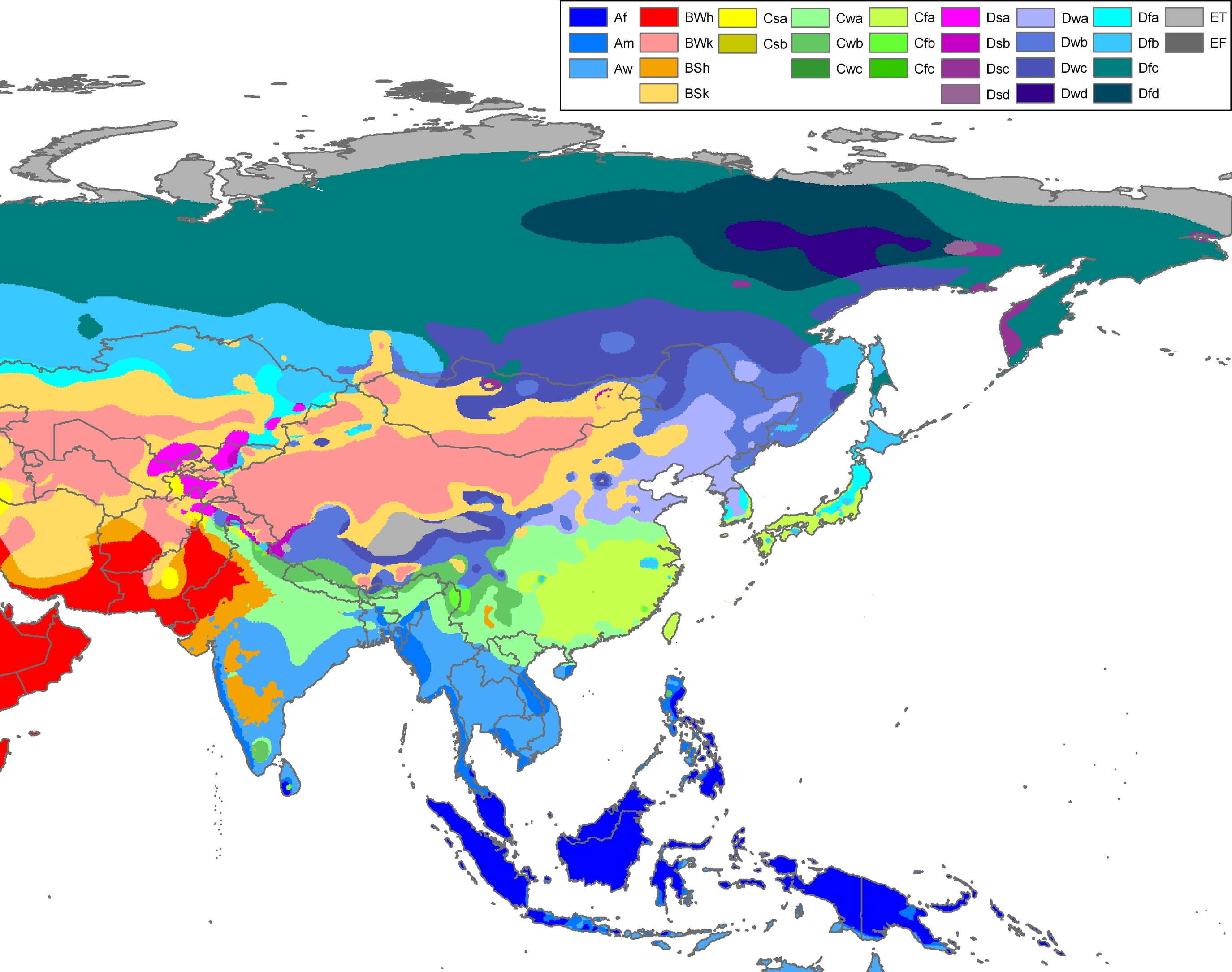
Baoding has a continental, monsoon-influenced humid continental climate/semi-arid climate (Köppen Dwa/BSk),[21] characterised by hot, humid summers due to the East Asian monsoon, and generally cold, windy, very dry winters that reflect the influence of the vast Siberian anticyclone. Spring can bear witness to sandstorms blowing in from the Mongolian steppe, accompanied by rapidly warming, but generally dry, conditions. Autumn is similar to spring in temperature and lack of rainfall. The annual rainfall, about 60% of which falls in July and August alone, is highly variable and not reliable. The average annual runoff is 2.45 billion cubic meters.[2] In the city itself, this amount has averaged to a meagre 496.1 millimetres (19.5 in) per annum. The monthly 24-hour average temperature ranges from −2.7 °C (27.1 °F) in January to 27.1 °C (80.8 °F) in July, and the annual mean is 13.3 °C (55.9 °F). There are 2,500 to 2,900 hours of bright sunshine annually, and the frost-free period lasts 165−210 days.
Administrative divisions
Bǎodìng prefecture-level city consists of 5 municipal districts, 4 county-level cities, 15 counties:
| Map | |||||||||||||
|---|---|---|---|---|---|---|---|---|---|---|---|---|---|
| ! scope="col" rowspan=2 | Division code[22] | ! scope="col" rowspan=2 | English name | ! scope="col" rowspan=2 | Simp. Chinese | ! scope="col" rowspan=2 | Pinyin | ! scope="col" rowspan=2 | Area in km2[23] | ! scope="col" rowspan=2 | Seat | ! scope="col" rowspan=2 | Postal code | ! scope="col" colspan=6 | Divisions[24] | ||||||
| ! scope="col" width="45" | Subdistricts | ! scope="col" width="45" | Towns | ! scope="col" width="45" | Townships | ! scope="col" width="45" | Ethnic townships | ! scope="col" width="45" | Residential communities (居委会) | ! scope="col" width="45" | Villages (村委会) | ||||||||
| 130600 | Baoding | 保定市 | Bǎodìng Shì | 22185 | Jingxiu District | 071000 | 31 | 207 | 105 | 2 | 514 | 6184 | |
| 130602 | Jingxiu District | 竞秀区 | Jìngxiù Qū | 149 | Xianfeng Subdistrict (先锋街道) | 071000 | 5 | 2 | 4 | 81 | 71 | ||
| 130603 | Lianchi District | 莲池区 | Liánchí Qū | 82 | Wusi Road Subdistrict (五四路街道) | 071000 | 10 | 2 | 5 | 151 | 120 | ||
| 130605 | Mancheng District | 满城区 | Mǎnchéng Qū | 658 | Mancheng Town (满城镇) | 072100 | 1 | 6 | 6 | 16 | 183 | ||
| 130606 | Qingyuan District | 清苑区 | Qīngyuàn Qū | 856 | Qingyuan (清苑镇) | 071100 | 13 | 5 | 14 | 266 | |||
| 130607 | Xushui District | 徐水区 | Xúshuǐ Qū | 723 | Ansu (安肃镇) | 072500 | 10 | 4 | 28 | 304 | |||
| 130633 | Yi County | 易县 | Yì Xiàn | 2535 | Yizhou (易州镇) | 074200 | 11 | 16 | 1 | 10 | 469 | ||
| 130630 | Laiyuan County | 涞源县 | Láiyuán Xiàn | 2431 | Laiyuan (涞源镇) | 074300 | 10 | 7 | 8 | 283 | |||
| 130626 | Dingxing County | 定兴县 | Dìngxīng Xiàn | 714 | Dingxing (定兴镇) | 072600 | 9 | 7 | 23 | 274 | |||
| 130636 | Shunping County | 顺平县 | Shùnpíng Xiàn | 712 | Puyang (蒲阳镇) | 072200 | 6 | 4 | 4 | 237 | |||
| 130627 | Tang County | 唐县 | Táng Xiàn | 1414 | Renhou (仁厚镇) | 072300 | 11 | 9 | 8 | 345 | |||
| 130631 | Wangdu County | 望都县 | Wàngdū Xiàn | 358 | Wangdu (望都镇) | 072400 | 7 | 1 | 10 | 142 | |||
| 130623 | Laishui County | 涞水县 | Láishuǐ Xiàn | 1662 | Laishui (涞水镇) | 074100 | 12 | 3 | 6 | 284 | |||
| 130628 | Gaoyang County | 高阳县 | Gāoyáng Xiàn | 496 | Gaoyang (高阳镇) | 071500 | 1 | 7 | 11 | 149 | |||
| 130632 | Anxin County | 安新县 | Ānxīn Xiàn | 728 | Anxin (安新镇) | 071600 | 9 | 4 | 5 | 223 | |||
| 130638 | Xiong County | 雄县 | Xióng Xiàn | 513 | Xiongzhou (雄州镇) | 071800 | 8 | 4 | 7 | 287 | |||
| 130629 | Rongcheng County | 容城县 | Róngchéng Xiàn | 311 | Rongcheng (容城镇) | 071700 | 5 | 3 | 4 | 127 | |||
| 130634 | Quyang County | 曲阳县 | Qūyáng Xiàn | 1076 | Hengzhou (恒州镇) | 073100 | 11 | 16 | 10 | 367 | |||
| 130624 | Fuping County | 阜平县 | Fùpíng Xiàn | 2494 | Fuping (阜平镇) | 073200 | 8 | 5 | 5 | 209 | |||
| 130637 | Boye County | 博野县 | Bóyě Xiàn | 331 | Boye (博野镇) | 071300 | 7 | 11 | 133 | ||||
| 130635 | Li County | 蠡县 | Lǐ Xiàn | 653 | Liwu (蠡吾镇) | 071400 | 11 | 2 | 7 | 232 | |||
| 130682 | Dingzhou City | 定州市 | Dìngzhōu Shì | 1284 | Nanchengqu Subdistrict (南城区街道) | 073000 | 4 | 16 | 5 | 1 | 31 | 470 | |
| 130681 | Zhuozhou City | 涿州市 | Zhuōzhōu Shì | 751 | Shuangta Subdistrict (双塔街道) | 072700 | 3 | 10 | 1 | 39 | 402 | ||
| 130683 | Anguo City | 安国市 | Ānguó Shì | 485 | Qizhouyaoshi Subdistrict (祁州药市街道) | 071200 | 2 | 6 | 3 | 6 | 198 | ||
| 130684 | Gaobeidian City | 高碑店市 | Gāobēidiàn Shì | 674 | Xinghua Road Subdistrict (兴华路街道) | 074000 | 5 | 10 | 19 | 409 | |||
| Xiong'an New Area | 雄安新区 | Xióng'ān Xīnqū | 106.46 | Rongcheng (容城镇) | |||||||||
| Note: Baoding New High Technology Product Development Zone (保定高新技术产业开发区) includes Damafang Township (大马坊乡) of Jingxiu District and Jiantai Township (贤台乡) of Mancheng District; the Baigou New City (白沟新城) includes Baigou Town (白沟镇) of Gaobeidian City. | |||||||||||||
- Dissolved districts: Beishi District and Nanshi District
Demographics
| Division name | ||||
|---|---|---|---|---|
| ! scope="col" colspan=3 | Residence population[25] (November 2010) | ! scope="col" rowspan=2 | Hukou population[26] (end of 2010) | |||
| ! scope="col" width="70" | Total | ! scope="col" width="70" | Ratio (%) | ! scope="col" width="70" | Population density (persons/km2) | ||
| Baoding City | 11,194,379 | 100 | 504.55 | 11610199 |
| Xinshi District | 482,768 | 4.31 | 2540.88 | 459038 |
| Beishi District | 387,339 | 3.46 | 5164.52 | 322205 |
| Nanshi District | 287,784 | 2.57 | 2877.84 | 279725 |
| Mancheng District | 387,307 | 3.46 | 615.75 | 411417 |
| Qingyuan District | 631,659 | 5.64 | 728.56 | 648645 |
| Laishui County | 339,063 | 3.03 | 204.50 | 352993 |
| Fuping County | 205,299 | 1.83 | 82.28 | 223846 |
| Xushui County | 563,030 | 5.03 | 778.74 | 586104 |
| Dingxing County | 517,873 | 4.63 | 725.31 | 585913 |
| Tang County | 529,066 | 4.73 | 373.37 | 590575 |
| Gaoyang County | 345,160 | 3.08 | 695.89 | 340163 |
| Rongcheng County | 258,179 | 2.31 | 822.23 | 265389 |
| Laiyuan County | 260,678 | 2.33 | 106.49 | 283537 |
| Wangdu County | 250,014 | 2.23 | 781.29 | 265525 |
| Anxin County | 437,378 | 3.91 | 604.11 | 440817 |
| Yi County | 537,564 | 4.80 | 212.14 | 570806 |
| Quyang County | 588,559 | 5.26 | 542.95 | 610065 |
| Li County | 505,574 | 4.52 | 775.42 | 532322 |
| Shunping County | 295,764 | 2.64 | 417.75 | 317484 |
| Boye County | 245,504 | 2.19 | 741.70 | 268941 |
| Xiong County | 359,506 | 3.21 | 686.08 | 375470 |
| Zhuozhou City | 603,535 | 5.39 | 813.39 | 645542 |
| Dingzhou City | 1,165,182 | 10.41 | 914.59 | 1214852 |
| Anguo City | 370,314 | 3.31 | 761.96 | 409834 |
| Gaobeidian City | 640,280 | 5.72 | 938.83 | 608991 |
| Note: The 58,709 people residing in Baoding High Technology Product Development Zone and the 124,274 in the Baigou New City are not listed separately. | ||||
According to the 2010 Census, the residence population stood at 11,194,382, an increase of 605,100 (5.71%) from 2000. The male-female ratio was 101.94:100. Children aged up to 14 numbered 1,915,800 (17.11% of the population), citizens 15 to 64 numbered 8,370,600 (74.78%), and 65+ numbered 908,000 (8.11%). The urban area of Baoding made of 5 urban Districts had a population of around 2,739,887 (2010 census). The overwhelming majority of the population is Han Chinese. The language of Baoding is Mandarin Chinese — specifically, the Baoding dialect of Ji-Lu Mandarin. Despite Baoding's proximity to Beijing, the Chinese spoken in Baoding is not particularly close to the Beijing dialect — rather, it is more closely related to Tianjin dialect.
Economy
Baoding is located in the centre of the Bohai Rim economic area which includes Beijing, Tianjin, and Shijiazhuang. One of the largest employers in Baoding is China Lucky Film, the largest photosensitive materials and magnetic recording media manufacturer in China.[27] And, Yingli group, 2010 World Cup sponsor, has its headquarters in Baoding, who is the Global Top 10 solar panel manufacturer. More renowned companies include ZhongHang HuiTeng Windpower Equipment Co., Ltd (Wind Turbine), Baoding Tianwei Group Co., Ltd (Transformer), and Great Wall Motor.
In April 2017, an area in Baoding was designated as a Xiong'an New Area, a development zone of initially 100 km2 and up to 2000 km2, the site of what will eventually be a new city and the hub of the Beijing-Tinajin-Hebei development area.
- Baoding High-tech Industrial Development Zone
Great Wall Motors Company Limited is a Chinese automobile manufacturer headquartered in Baoding, Hebei, China. The company is named after the Great Wall of China and was formed in 1984. It is China's largest sport utility vehicle (SUV) and pick-up truck producer. It sells passenger cars and trucks under the Great Wall brand and SUVs under the Haval and WEY brands.
In 2016, Great Wall Motors set a historical sales record of 1,074,471 cars worldwide, increased by 26% compared to 2015.
Renewable energy
Baoding City has one of China's biggest plants which manufactures blades used in wind turbine generators, catering mainly to the domestic market. Tianwei Wind Power Technology is one of the three main plants in Baoding that produces wind turbine generators. It wheeled out its first 20 turbines in 2008, and it will produce 150 units in 2009 and another 500 in 2010. Nevertheless, Baoding is currently listed as the most polluted city in China.[28]
Transport
Baoding has good connections to other cities, being located on one of the main routes in and out of Beijing.
Road
The Jingshi Expressway connects the two cities, and Baoding is also the western terminus of the Baojin Expressway linking Baoding with Tianjin, which is one out of two nearest ports (Huanghua is the other one).
Rail
The Jingguang Railway provides frequent services to Beijing West railway station. On 30 December 2012, a new Baoding station was opened, while the old train station was closed for passengers.[29] Baoding East railway station lies 9.5 km (5.9 mi) to the east on the Beijing–Guangzhou–Shenzhen–Hong Kong high-speed railway. On October 1, 2018, the east square of Baoding Railway Station was officially put into use, and the east station building of the railway station was also opened at the same time.[30]
Military
Baoding is headquarters of the 38th Mechanized Group Army of the People's Liberation Army, one of the three group armies that comprise the Beijing Military Region responsible for defending the PRC capital.[31]
Culture
Perhaps the best-known item to supposedly originate in Baoding are Baoding balls, which can be used to relax one's keyboard hand and strengthen one's wrist.[32]
The most famous local specialty food is the donkey burger.[33] () Anxin County is home to the Quantou Village Music Association (), a well-known traditional music group performing on guan (oboes), sheng (mouth organs), and percussion. The village of Quantou is located on an island in Lake Baiyangdian.[34] The city's streets follow a rough grid pattern, although this is less obvious in the older part of the city. The traditional main street of old Baoding is Yuhua Road, running from the city's centre to its eastern edge. Most of Baoding's historic buildings are located in this area, along with some of its larger shopping centres.[35] Other major streets include Dongfeng Road and Chaoyang Avenue. There is a ring road around the city. Baoding is home to Hebei University, North China Electric Power University, three other universities and twelve colleges.[36]
Historic sites
Baoding contains a number of notable historic sites. In the city proper, there can be found a historic provincial governor's mansion and an ancient lotus garden. In the hills to the northwest of the city, near the suburb of Mancheng, there are the Mancheng Han Tombs, where Prince Liu Sheng and his wife Dou Wan were buried.
The greater Baoding administrative area has 16 designated state-level cultural relics:
- Yan State Capital Relics (475BC-221BC, Yixian County)
- Great Wall at Zijinguan Pass (1368–1644, Yixian County and Laiyuan County)
- Stele of Lao Tzu's Tao Te Ching (618-907, Yixian County)
- Western Qing Tombs (1730–1915, Yixian County)
- Geyuan Temple (916-1125, Laiyuan County)
- Ciyun Pavilion (1306, Dingxing County)
- Yicihui Stone Pillar (550-577, Dingxing County)
- Kaiyuan Temple (960-1127, Dingzhou County)
- Kaishan Temple (618-907, Gaobeidian County)
- Dingzhou Porcelain Kiln Relic (960-1127, Quyang County)
- Beiyue Temple (386-543, Quyang County)
- Jin-cha-ji Border Region Headquarters Ruins (1938, Fuping County)
- Ranzhuang Underground Tunnel (1937–1945, Qingyuan County)
- Mancheng Han Tombs (154BC-113BC, Mancheng County)
- Zhili Provincial Governor Office (1730–1911, Baoding)
- Historical Site of the Baoding Military Academy (1902–1923)
Notable people
- Abbie Goodrich Chapin (1868–1956), American missionary teacher based in Baoding
- Chen Xu, Director of the Overseas Chinese Affairs Office
- Fan Hongbin—gymnast, Olympic silver medalist in 1996 Summer Olympics
- Fan Ye—gymnast, 2003 World Artistic Gymnastics Championships balance beam gold medalist
- Guo Jingjing—diver and Olympic gold medalist in 2004 and 2008 Summer Olympics
- Qian Hong—swimmer and Olympic gold medalist in 1992 Summer Olympics
- Shi Changxu—materials scientist, recipient of the 2010 State Preeminent Science and Technology Award
- Tie Ning—author, president of the China Writers Association
- Wei Jianjun—billionaire, chairman of Great Wall Motors[37]
- Yan Su—Chinese playwright and lyricist
- Xie Jun—chess grandmaster and Women's World Chess Champion 1991–1996, 1999–2001
- Zhang Shangwu–gymnast, 2001 Summer Universiade still rings gold medalist
Sister cities
- United States, Charlotte, North Carolina, 1987-09-29[39]
- Japan, Yonago, Tottori, 1991-10-13[40]
- Japan, Saijō, Ehime, 1994-9-21[41]
- Iceland, Hafnarfjörður, 1994-10-09[42]
- Japan, Kushima, Miyazaki, 2000-11-20[43]
- South Korea, Dongdaemun District, Seoul, 2001-02-19[44]
- Canada, Gravenhurst, Ontario, 2002-12-5[45]
- Panama, Santiago de Veraguas, 2006-12-15[46]
- Denmark, Sønderborg Municipality, 2012-04-23[47][48]
See also
References
- ^ "zh:概况" (in Chinese). Baoding People's Government. Archived from the original on 27 April 2011. Retrieved 2011-05-20.
- ^ "保定简介-保定市戴维软件科技有限公司" [Introduction to Baoding - Baoding David Software Technology Co., Ltd.]. baoding.daiwei.com. Retrieved 2024-12-14.
- ^ "(河北省)保定市2024年国民经济和社会发展统计公报-红黑统计公报库" [(Hebei Province) Baoding City 2024 Statistical Communiqué on National Economic and Social Development - Honghei Statistical Communiqué Database]. tjgb.hongheiku.com. Retrieved 2025-11-26.
- ^ "zh:最新中国城市人口数量排名(根据2010年第六次人口普查)". www.elivecity.cn. 2012. Archived from the original on 2015-03-03. Retrieved 2014-05-28.
- ^ "城变:京津冀这十年-报纸网络-北京市发展和改革委员会" [Urban Transformation: A Decade of Beijing-Tianjin-Hebei - Newspaper & Web - Beijing Municipal Development and Reform Commission]. fgw.beijing.gov.cn. Retrieved 2024-11-16.
- ^ "《保定市城市总体规划(2011-2020年)》" [Baoding City Master Plan (2011-2020)]. 保定市人民政府. Archived 2018-08-14 at the Wayback Machine. Retrieved 2017-07-02.
- ^ "保定两县,以州为名且均为千年古县,其一曾被誉为"天下第一州"". www.visitbeijing.com.cn. Retrieved 2024-12-14.
- ^ Leon E. Seltzer (ed.) (1952). "Paoting". The Columbia Lippincott Gazetteer of the World. Morningside Heights, NY: Columbia University Press. p. 1425. OCLC 802473294
- ^ "Pao-ting or Pao·ting". The International Geographic Encyclopedia and Atlas. Boston: Houghton Mifflin Company. 1979. p. 591. ISBN 0-395-27170-3. LCCN 79-2721. OCLC 5171913
- ^ "保定_央广网" [Baoding _ CNR.cn]. news.cnr.cn. Retrieved 2024-11-16.
- ^ "涨知识|保定为什么叫"保定"". The Paper. 2019-08-16. Retrieved 2025-04-20.
- ^ Liu, Li (2005). The Chinese Neolithic: Trajectories to Early States. Cambridge University Press. p. 24. ISBN 9781139441704.
- ^ "文物资源_河北省文物局" [Cultural Relics Resources _ Hebei Provincial Bureau of Cultural Relics]. wenwu.hebei.gov.cn. Retrieved 2024-11-16.
- ^ George Modelski, World Cities: –3000 to 2000, Washington DC: FAROS 2000, 2003. ISBN 0-9676230-1-4.
- ^ Shi Weile (ed.) (2005). Zhongguo Lishi Diming Da Cidian (中国历史地名大词典)' [Large Dictionary of Chinese Historical Place Names] (in Chinese). China Social Sciences Press. p. 1917. ISBN 7-5004-4929-1.
- ^ "四处流浪的河北省会 | 中国国家地理网" [The Wandering Provincial Capital of Hebei | Chinese National Geography]. www.dili360.com. Retrieved 2024-11-16.
- ^ "方舆 - 北部 - 关于我国县市最密集的河北省行政区划调整研究:增地级市并小县 - Powered by phpwind". xzqh.info. Retrieved 2024-11-16.
- ^ "中共中央、国务院决定设立河北雄安新区_图片新闻_中国政府网" [CPC Central Committee and State Council Decide to Establish Hebei Xiong'an New Area _ Photo News _ Gov.cn]. www.gov.cn. Retrieved 2024-11-16.
- ^ "河北概况" [Hebei Overview]. www.hebei.gov.cn. Retrieved 2024-11-16.
- ^ "List of municipal river and lake chiefs in Baoding City" (in zh-cn). 2022. Retrieved 2023-02-21.[dead link]
- ^ Peel, M. C. and Finlayson, B. L. and McMahon, T. A. (2007). "Updated world map of the Köppen-Geiger climate classification". Hydrol. Earth Syst. Sci. 11: 1633-1644. ISSN 1027-5606.
- ^ "zh:国家统计局统计用区划代码" (in zh-cn). National Bureau of Statistics of the People's Republic of China. 2011. Archived from the original on 2012-04-07. Retrieved 2013-01-01.
- ^ 《保定经济统计年鉴2011》[full citation needed]
- ^ 《中国民政统计年鉴2012》[full citation needed]
- ^ 《保定市2010年第六次全国人口普查主要数据公报》[full citation needed]
- ^ 《中华人民共和国全国分县市人口统计资料2010》[full citation needed]
- ^ "About Baoding City". Archived from the original on 2009-03-04. Retrieved 2008-12-14.
- ^ "China names 10 most polluted cities". Retrieved 2016-10-08.
- ^ "Baoding new railway station". 3 January 2013. Retrieved 2013-01-03.
- ^ "zh:保定火车站东广场正式投入使用" [Baoding Railway Station East Plaza officially put into use]. The Paper online newspaper澎湃新闻. Baoding Release保定发布. Retrieved 2023-02-10.
- ^ "军史" [Military History]. www.rongwp.com. Retrieved 2024-11-16.
- ^ "非遗之魅 | 手指上的舞蹈——保定铁球" [Charm of Intangible Cultural Heritage | Dance on the Fingertips — Baoding Iron Balls]. www.visitbeijing.com.cn. Retrieved 2026-03-18.
- ^ "经典美味:驴肉火烧的历史起源" [Classic Delicacy: The Historical Origin of Donkey Meat Huoshao]. story.importfood.net. Retrieved 2026-03-18.
- ^ "安新圈头村音乐会-国家级非物质文化遗产(安新)" [Anxin Quantou Village Music Association - National Intangible Cultural Heritage (Anxin)]. m.chinaquhua.cn. Retrieved 2026-03-18.
- ^ "上有北京,下有保定(3)·沿着裕华西路寻古迹,走读保定近代史" [Beijing Above, Baoding Below (3) · Seeking Monuments Along Yuhua West Road, Reading Through the Modern History of Baoding]. www.sohu.com. Retrieved 2026-03-18.
- ^ 网易 (2021-04-05). "河北保定:不大的城市,却有如此多的高校" [Hebei Baoding: A small city, yet with so many universities]. www.163.com. Retrieved 2026-03-18.
- ^ "Wei Jianjun". Forbes. Retrieved 3 January 2015.
- ^ "Sister cities 友好城市" (in Chinese). baoding.gov.cn. Baoding Municipal People's Government Foreign Affairs Office. Retrieved 2023-02-22.
- ^ "International Relations". charlottenc.gov. City of Charlotte. Archived from the original on 2022-09-27. Retrieved 2023-02-22.
- ^ "Sister cities 友好都市・姉妹都市" (in Japanese). city.yonago.lg.jp. City of Yonago. Retrieved 2023-02-22.
- ^ "International exchange activated with globalization". pref.ehime.jp. Ehime Prefecture. Retrieved 2023-02-22.
- ^ "Vinabærinn" (in Icelandic). hafnarfjordur.is. Hafnarfjörður. 28 June 2022. Retrieved 2023-02-22.
- ^ "Sister Cities/Friendship Cities姉妹都市・友好都市" (in Japanese). city.kushima.lg.jp. Kushima City Hall. Retrieved 2023-02-22.
- ^ "Sisterhood Cities Anguo Hebei Province China". ddm.go.kr. Dongdaemun-gu. Retrieved 2023-02-22.
- ^ "Relationship between China and the Province of Ontario". toronto.china-consulate.gov.cn. Consulate-General Of The People's Republic Of China in Toronto. Retrieved 2023-02-22.
- ^ "Santiago圣地亚哥市" (in Chinese). hebwb.hebei.gov.cn. Hebei People's Association For Friendship With Foreign Countries. Retrieved 2023-02-22.
- ^ "Green Urban Denmark". ens.dk. The Danish Energy Agency and Danish Ministry of Housing, Urban and Rural Affairs. Retrieved 2023-02-25.
- ^ "驻丹麦大使李瑞宇会见森讷堡市长Aase Nyegaard女士" [Chinese Ambassador to Denmark Li Ruiyu meets with Ms. Aase Nyegaard, Mayor of Sønderborg]. dk.china-embassy.gov.cn. Retrieved 2026-03-18.
- Preston, Diana (2000). The Boxer Rebellion: The Dramatic Story of China's War on Foreigners That Shook the World in the Summer of 1900. illustrated, reprint ed. Bloomsbury Publishing USA. ISBN 0802713610. Retrieved 24 April 2014.