| Status | LC |
|---|---|
| Status system | IUCN3.1 |
| Genus | Prunus |
| Parent | Prunus subg. Cerasus |
| Species | emarginata |
| Authority | (Dougl. ex Hook.) Eaton |
Prunus emarginata, the bitter cherry[1] or Oregon cherry, is a species of Prunus native to western North America.
Taxonomy
There are two varieties:[2][1]
- Prunus emarginata var. emarginata. Usually shrubby; young shoots and leaves hairless or only thinly hairy. Most of the species' range.
- Prunus emarginata var. mollis (Dougl.) Brew. A larger tree; young shoots and leaves downy. Reddish-brown bark with light horizontal bands resembling water birch.[3] Oregon north to British Columbia, mainly coastal.
Description
Prunus emarginata is a deciduous shrub or small tree growing to 1–15 metres (3.3–49.2 feet) tall;[4] west of the Cascade Range, it commonly reaches 80-100 ft tall. It has a slender oval trunk and smooth gray to reddish-brown bark with horizontal lenticels. The leaves are 2–8 centimetres (0.79–3.15 inches) long, thin, egg-shaped,[4] and yellowish-green with unevenly sized teeth on either side.
The flowers are small, 10–15 millimetres (0.39–0.59 in) diameter, with five white petals[4] and numerous hairlike stamens; they are almond-scented, produced in clusters in spring, and pollinated by insects.
The fruit is a juicy red or purple cherry 7–14 mm (0.28–0.55 in) diameter, which, as the plant's English name suggests, are bitter.[4] As well as reproducing by seed, it also sends out underground stems which then sprout above the surface to create a thicket.[2][5][6]
Similar species
Prunus pensylvanica, the pin cherry, is closely related.[3]
Distribution and habitat
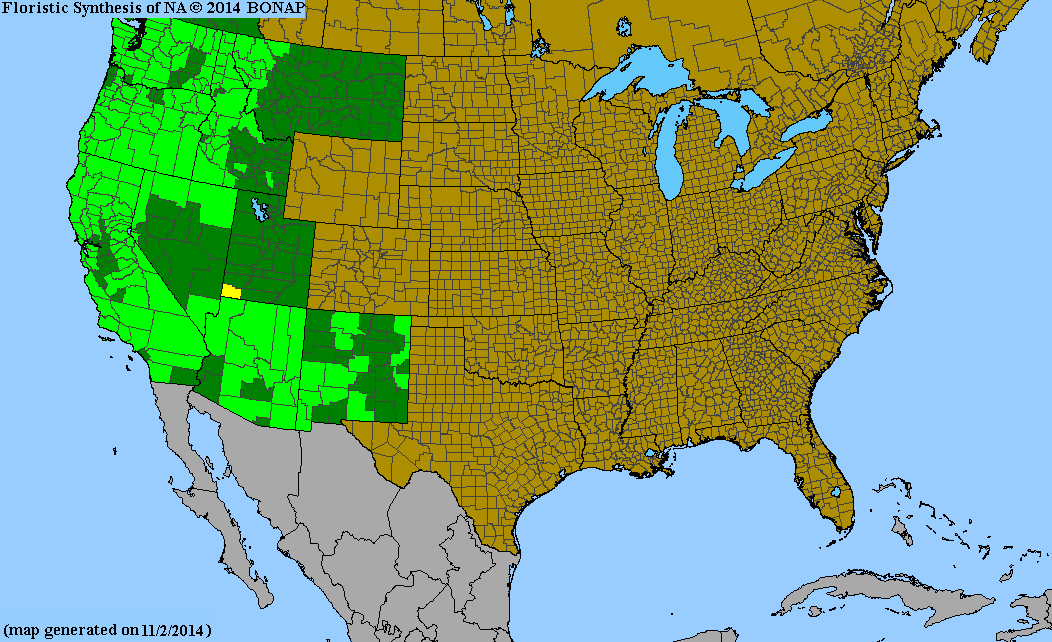
It is native to western North America from British Columbia south to Baja California, and east as far as western Wyoming and New Mexico.[7][8] It is often found in recently disturbed areas or open woods on nutrient-rich soil.[9][2][5]
Ecology
Mammals, deer and livestock forage on the leaves.[10] The cherries are eaten by some birds (especially cedar waxwing),[11] who in turn distribute the seeds.[3] The seeds have hard shells which can preserve them for decades before being released by fire.[3]
The tree is a larval host to the blinded sphinx, elegant sphinx, Lorquin's admiral, pale tiger swallowtail, small-eyed sphinx, spring azure, twin-spotted sphinx, and western tiger swallowtail.[12]
Cultivation
It has hybridized with the introduced European Prunus avium in the Puget Sound area; the hybrid has been named Prunus × pugetensis. It is intermediate between the parent species, but is nearly sterile, producing almost no cherries.[13]
Uses
The extremely bitter cherries are inedible to humans.[11] Native Americans used the bark in basket making.[3]
Medicinal
Native tribes, most notably Kwakwaka'wakw, used parts of the plant for medicinal purposes, such as poultices and bark infusions.[14] The isoflavone prunetin was isolated for the first time by Finnemore in 1910 from the bark of P. emarginata.[15]
References
- ^
- ^ Plants of British Columbia: Prunus emarginata
- ^ Arno, Stephen F. & Hammerly, Ramona P. (2020 [1977]). Northwest Trees: Identifying & Understanding the Region's Native Trees. field guide ed. Seattle: Mountaineers Books. pp. 242–245. ISBN 978-1-68051-329-5. OCLC 1141235469
- ^ Turner, Mark & Kuhlmann, Ellen (2014). Trees & Shrubs of the Pacific Northwest. 1st ed. Portland, OR: Timber Press. p. 252. ISBN 978-1-60469-263-1.
- ^ Jepson Flora: Prunus emarginata
- ^ Flora of North America, Prunus emarginata (Douglas) Eaton, Man. Bot. ed. 7. 463. 1836. Bitter cherry
- ^ Biota of North America Program 2014 county distribution map
- ^ SEINet, Southwestern Biodiversity, Arizona chapter photos, description, distribution map
- ^
- ^ Little, Elbert L. (1994 [1980]). The Audubon Society Field Guide to North American Trees: Western Region. Chanticleer Press ed. Knopf. p. 467. ISBN 0394507614.
- ^ Peattie, Donald Culross (1953). A Natural History of Western Trees. New York: Bonanza Books. p. 538.
- ^ The Xerces Society (2016), Gardening for Butterflies: How You Can Attract and Protect Beautiful, Beneficial Insects, Timber Press.
- ^ Jacobson, A. L. & Zika, P. F. (2007). A new hybrid cherry, Prunus × pugetensis (P. avium × emarginata, Rosaceae), from the Pacific Northwest. Madroño 54: 74–85. Abstract
- ^ Casebeer, M. (2004). Discover California Shrubs. Sonora, California: Hooker Press. ISBN 0-9665463-1-8
- ^ Isoflavones. III. The structure of prunetin and a new synthesis of genistein. R. L. Shriner, C. J. Hull, J. Org. Chem., 1945, 10 (4), pp 288–291