| Background | solo_singer |
|---|---|
| Birth name | Miklós Voglhut |
| Alias | Miklós Vig |
| Birth date | 11 July 1898 |
| Birth place | Budapest, Austria-Hungary |
| Death date | 19 December 1944 (aged 46) |
| Death place | Budapest, Hungary |
| Origin | Hungary |
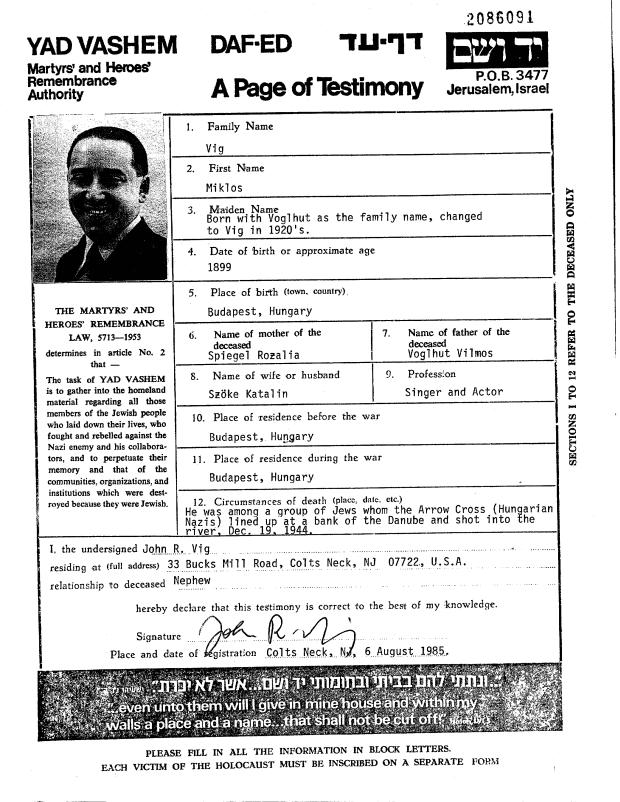
Miklós Vig (11 July 1898 – 19 December 1944) was a Hungarian cabaret[1] and jazz[2][3] singer, actor, comedian[4] and theater secretary[1] in the 1920s, 1930s, and 1940s. Born in Budapest on 11 July 1898, he was murdered there on 19 December 1944 by members of the Arrow Cross Party.[5]
Background and biography
Early life
Vig was born Miklós Voglhut[6] in 1898 to Vilmos Vogelhut (1867-1942) and Roza Vogelhut (1870-1942) in a Hungarian Jewish family in Budapest, Hungary.[7][1] Although he went to acting school, he had better success as a cabaret singer. In 1924 as his career was picking up he changed his surname to Vig,[6] because Voglhut was a Jewish-sounding name and antisemitism was growing at the time. Vig means cheerful or merry in Hungarian.[6]
Family
Other musicians from the Vig family include Vig's brother, saxophone and clarinet player György Vig,[3] and his nephew, jazz musician Tommy Vig.[8] Another nephew, John Vig, is a physicist and was president of the Institute of Electrical and Electronics Engineers in 2009.
Murder
The fact that Vig was married to a Catholic woman, Kató Szőke, and the fact that he changed his name, did not save him from the Holocaust. On 19 December 1944 he was among a group of Jews who were bound, lined up along the banks of the Danube and machine-gunned into the river by Hungarian Nazis, members of the Arrow Cross Party.[citation needed] The Shoes on the Danube Promenade commemorates those who were murdered in this fashion.
Music and comedy
Vig had his first major successes as a soloist, and later performed frequently in other cabarets including the Budapest Operetta Theatre and Budapest Orfeum. Although he made many recordings, he became most famous as a singer of popular music on the radio.[1] A 1935 article in Színházi Élet described Vig as a singer of popular sentimental songs.[9]
According to Gramofon (the Hungarian Jazz and Classical music magazine), Vig was considered part of the first generation of recorded Hungarian musicians.[10] When Deutsche Gramophone found themselves falling behind the competition, they signed Vig, who became their first dance-music star.[10]
As a comedian, he performed in the early 1920s at various cabarets including the Rakéta Kabaré, occasionally with female partner Annus Nagy.[4]
Discography
References
- ^ Hungarian Electronic Library (in Hungarian)
- ^ The JAZZ Discography
- ^ Magyar Jazzkutatási Társaság (in Hungarian)
- ^ SzocHáló Társadalomtudomány Archived 2024-05-24 at archive.today (in Hungarian)
- ^ Yad Vashem A Page of Testimony
- ^ Voglhut Family History, by Imre Voglhut, unpublished
- ^ "Miklós Vig". geni_family_tree. 29 April 2022. Retrieved 2022-05-26.
- ^ "All About Jazz". Archived from the original on 2012-10-21. Retrieved 2008-03-04.
- ^ Ökotáj Színházi Élet, 1935. 32. szám (in Hungarian)
- ^ Gramofon – Klasszikus és Jazz 1997.10.01 by Oldal Gábor (in Hungarian)
- ^ Discographie der österreichischen Populärmusik Erfassung österreichischer Tanz-, Jazz- und U-Musikaufnahmen 1900 - 1958
- ^ Hungarian Jazz Discography 1905-2000 by Géza Gábor Simon, Budapest, 2005. ISBN 963-219-002-5
- ^ Szerenád Média (in Hungarian)