 | You can help expand this article with text translated from the corresponding article in German. (April 2012) Click [show] for important translation instructions.
|
Grabow | |
|---|---|
 Town hall and marketplace with St. Georgs church in the background | |
 Flag  Coat of arms | |
Location of Grabow
within Ludwigslust-Parchim district
| |
 Location of Grabow | |
  Grabow  Grabow | |
| Coordinates: 53°16′N 11°34′E / 53.267°N 11.567°E | |
| Country | Germany |
| State | Mecklenburg-Vorpommern |
| District | Ludwigslust-Parchim |
| Municipal assoc. | Grabow |
| Government | |
| • Mayor | Kathleen Bartels (SPD) |
| Area | |
• Total | 72.27 km2 (27.90 sq mi) |
| Elevation | 26 m (85 ft) |
| Population (2024-12-31)[1] | |
• Total | 5,422 |
| • Density | 75.02/km2 (194.3/sq mi) |
| Time zone | UTC+01:00 (CET) |
| • Summer (DST) | UTC+02:00 (CEST) |
| Postal codes | 19300 |
| Dialling codes | 038756 |
| Vehicle registration | LWL, LUP |
| Website | www.grabow.de |
_in_LUP.svg)
Grabow (German pronunciation: [ˈɡʁaːboː] ⓘ) is a town in the Ludwigslust-Parchim district of Mecklenburg-Vorpommern, Germany. The town lies 7 kilometres (4.3 mi) southeast of Ludwigslust, the next city, and has the river Elde passing through its old town which is characterized by 16th century timber-framed architecture. Additionally, Grabow is a member and the seat of the Amt Grabow collective municipality as well as being a part of the Hamburg Metropolitan Region. Historically, Grabow was home to a royal residence where some monarchs of the Mecklenburg line were born.
Etymology
The name Grabow is of Slavic Polabian origin, with grab meaning "hornbeam".[2] Names of the same root are common in the area. Its name only slightly changed over time as with the town being known as Grabowe (1186, 1252, 1275) and Grabow (1189, 1298).
In contemporary times, Grabow is also referred to as Grabow (Elde) or Grabow in Mecklenburg, shortened to Grabow i. M. or Grabow (Mekl), to differentiate it from other settlements of the same name, with the latter being used in the official name of the Grabow (Meckl) train station.
Geography
Grabow is situated on the river Elde in the Griese Gegend region of southern Mecklenburg, close to the border of the state of Brandenburg (Prignitz district). It is surrounded by a scenic landscape of primarily forests, with the town forest inside Grabow's territory covering an area of 1,658 hectares (4,100 acres) or 16.58 square kilometres (6.40 sq mi).[3]
The town lies 7 kilometres (4.3 mi) southeast of Ludwigslust, 40 kilometres (25 mi) southeast of the state capital Schwerin, and 34 kilometres (21 mi) northwest of Wittenberge in Brandenburg. Clockwise, starting from the north, Grabow's core territory is bordered by the following municipalities: Groß Laasch, Muchow, Zierzow, Prislich, Kremmin, Gorlosen, Eldena, Karstädt, and Ludwigslust. The exclave Steesow is bordered by Milow to the north and Lenzen (Elbe) to the south.
Besides the main town itself, the municipality of Grabow includes several outlying villages in its hinterland. These include: Bochin, Fresenbrügge, Heidehof, Steesow, Wanzlitz, Winkelmoor, and Zuggelrade.[4]
The former municipality of Steesow, which also included the villages of Bochin of Zuggelrade as well as the Gemarkung Holdseelen, was annexed into Grabow on 1 January 2016[5] despite being separated by 15 kilometres (9.3 mi) and two other municipalities, Gorlosen and Milow, thus forming an exclave.[6] This exclave is the only part of Grabow that directly borders the state of Brandenburg as the core territory of the town is separated from the border by at minimum 2.5 kilometres (1.6 mi) and the municipality of Kremmin.
Grabow lies on the Berlin–Hamburg railway and is serviced by the RE8 via the Grabow (Meckl) station. The A14 highway bypasses Grabow to the west.
History
 County of Dannenberg (1186–1319/20)
 Duchy of Mecklenburg (1320–1471)
 County of Schwerin (1234–1471)
- Duchy of Mecklenburg (1471–1520)
 Duchy of Mecklenburg-Schwerin (1520–1695)
 Duchy of Mecklenburg (1695–1701)
- Duchy of Mecklenburg-Schwerin (1701–1815)
- Grand Duchy of Mecklenburg-Schwerin (1815–1866)
 North German Confederation (1866–1871)
- German Empire (1871–1918)
 Weimar Republic (1918–1933)
 Nazi Germany (1933–1945)
 Soviet Occupation Zone (1945–1949)
 East Germany (1949–1990)
 Germany (1990–present)
In a letter from 23 February 1186, Pope Urban III[2] mentioned a castle in Grabow and that the settlement belongs to the County of Dannenberg.[7][8] Grabow received town privileges in 1252 from the Count of Dannenberg.[2] A church in Grabow was first mentioned in 1285.[9]
Since 1319/20, Grabow has been a part of Mecklenburg under first the Duchy and then the Grand Duchy of Mecklenburg-Schwerin, under which it was incorporated into the German Empire.

The old town hall was built in 1687/88. On 3 June 1725, the vast majority of the town was destroyed by a great fire, this included the old town hall, which was rebuilt in 1728, remaining in use to this day; and the ducal palace, which was never rebuilt.[10] After the fire, the incumbent first mayors, Hans Scheffer and Franz Heinrich Accidalius, commenced the rebuilding of the town in its now iconic style of close core timber-framed houses which still characterize the old town.[7] The oldest building in Grabow dates to 23 May 1702, meaning that it survived the great fire.
As a result of the great fire, the Grabow Altarpiece, which was created in 1367 for the St. Petri church in Hamburg, was donated to the Grabow church 1726. It remained there until 1903 when it was bought by Alfred Lichtwark for the Hamburger Kunsthalle, returning it to Hamburg after its presence in Grabow for 177 years.[11]
The first known Jews in Grabow showed up in records starting in 1749. They were two men: Moses Wulff and Siemon Moses, that earned their privilege of Schutzjude on 20 November 1753. By 1767, at least four Jews lived in Grabow and a small community of Jews had formed in the town by 1780 at the latest who maintained a small burial ground.[12] A small synagogue may have also existed at the time, but was superseded by a new one, located at the intersection of Schulstraße and Wasserstraße, in 1798, which fell out of use before the 1930s, and was demolished in 1975.[13] Grabow's Jewish population peaked in 1819 with 44 (8 families).[14] Since the 18th century, Grabow has had a small Jewish cemetery, which the town maintains to this day.[15]
In 1805, the painter Wilhelm Langschmidt was born in Grabow and later settled in the Elgin valley in South Africa. The town which grew around his trading store there still bears the name Grabouw, after his hometown.[16]
On 1 July 1839, at the age of 28, Franz Floerke was elected mayor of Grabow with an absolute majority in the city council. His tenure, which at almost 50 years made him the longest-serving mayor in the town's history, was marked by prosperity and success. Arguably his biggest achievement was his advocacy for the construction of the Berlin–Hamburg railway through Grabow and the town's inclusion as a stop on the line; his endeavour successful, the first train arrived at the Grabow station from Berlin by noon on 15 October 1846 under applause of the residents. Floerke greatly contributed to the expansion of other infrastructure, such as bridges and roads; as well, while also promoting the settlement of industry in the town. His tenure ended upon his retirement on 1 January 1889, soon after which he died. He is commemorated by plaque on the town hall, a sculpture by Bernd Streiter, unveiled on 1 April 2016, and the road Floerkestraße which is named after him.[7][17][18][19]
During 1843, Grabow had a population of 3,781, thereof 32 Jews and 259 cavalrymen.[10]
World War II
The 1930 city council election was the last in Grabow before Nazi takeover had the following result: 8 Bürgerliche Liste, 5 SPD, 2 KPD. After the takeover, the city council was dissolved in November 1932 and reinstated in April 1933 with the following composition: 7 NSDAP, 5 SPD, 3 Kampffront Schwarz-Weiß-Rot. It was again dissolved in October 1935 and replaced by a council of 8 advisors to the mayor. The mayor at the time, Dr. Walter Bötcher, who had been in office since 1931, originally came from the DVP and only joined the NSDAP 1937. He was assisted by four 'temporary' vice-mayors and stayed in office until 1945.[20]
After Hitler's rise to power, Jews faced increased discrimination which culminated in the Kristallnacht, although it is unknown if the already out-of-use synagogue, which was sold 1932, and the Jewish cemetery were affected during this time. Most Jews in Grabow were deported to concentration camps and murdered during the Holocaust. They are remembered by several Stolpersteine in the town, the first of which being laid in 2014. The last known Jew in Grabow was Betty Londe, née Rosenthal, who was recorded to be in a Mischehe (mixed marriage) in 1942, which ensured that she survived World War II, albeit her family facing discrimination.[12]
Willi Fründt, a communist from Grabow, was deported to Neuengamme concentration camp and executed on 24 December 1944 as a result of Aktion Gitter.[21]
.jpg)
In early 1945, German refugees arrived in Grabow and foreshadowed the coming arrival of Soviet troops to the town. The Reichsstatthalter of the Gau Mecklenburg, Friedrich Hildebrandt, had ordered to barricade the town and to blow up all bridges crossing the Elde, in order to establish the river as a defensive line. The Stadtkommandant of Grabow however, a beloved general, wanted to protect Grabow from destruction by surrendering it peacefully, but when another combat group arrived in April to prepare defenses of the town, four of the town's residents secretly defused the explosives that had already been applied to the bridges and eventually convinced the major to surrender the town without a fight. Soon after the combat group had left, on 3 May, the town started being looted by primarily escaped forced labours of Polish and Russian descent, although residents of the town also participated in this. One day prior, to prevent persecution, parts of the Heinsius family, which had been the single largest employer in the town at the time, fled into the Duchy of Lauenburg; Walther Heinsius however opted to stay in the town and, together with Hermann Krüger, approached the Americans in Ludwigslust with a white flag, surrendering the town without a fight. However, when the American troops of the Ninth Army entered Grabow to occupy it one day later, they encountered Soviet forces, the 2nd Belorussian Front, that had arrived earlier that same day. Seeing this, the Ninth Army again withdrew from the town and drew the temporary demarcation line between Grabow and Ludwigslust on 1 July 1945, leaving Grabow on the Soviet side. The Soviet occupation in Grabow was similar to that in other ares occupied by the Red Army, characterized by the rape of around 80 women and girls as well as a continuation of the looting, particularly of the remaining alcohol. Multiple residents of Grabow committed suicide during March, among them the poet and author Gustav Ritter. Most of the notable NSDAP-members in the town were interrogated, arrested, and eventually deported to the NKVD special camp Fünfeichen in Neubrandenburg; a similar fate befell Walther Heinsius who was arrested and released multiple times before finally also being deported to the camp where he would die of starvation on 16 July 1946. A small group of five former local Jungvolk-leaders staged a small resistance to the occupation by posting anti-Soviet graffitis on some houses at night, among them "Down with Stalin, long live Germany!", they too, would eventually be arrested and deported to the Fünfeichen camp, which only one of them survived.[22][23] Since no fighting had taken place in the town, Grabow was nearly untouched by World War II.[2]
During their occupation, the Soviets would install Luka P. Boldin as the town's Stadtkommandant. Boldin reorganized the town's municipal administration and installed Lithuanian-born Edgar Stafels as the town's mayor. Once it was revealed however, that Stafels had been a criminal who previously served time in a Zuchthaus, he was arrested by the police chief Karl Brandt, who's custody Stafels escaped three days later. The Stadtkommandant replaced Stafels with the moderate old-communist Friedrich Jacobs.[22]
Since reunification
In 2005, the Amt Grabow-Land, which annexed the Amt Malliß in 2004,[24] and the town of Grabow were merged into the administrative unit Amt Grabow, which persists to this day.[8][25] The district of Ludwigslust, of which Grabow was a part, was merged with the district of Parchim on 4 September 2011, forming the new district of Ludwigslust-Parchim.[26]
On 1 January 2016, Grabow annexed the former municipality Steesow, which became an exclave separated by 15 kilometres (9.3 mi) from the core municipal territory.[5][6]
In 2024 Grabow participated in the Summer of Pioneers, a project attempting to help revive smaller towns.[27][28][29]
Demographics
As of the 2022 census, Grabow had a population of 5,436 (2023 estimate: 5,573), of which 2,781 (51.2%) are female and 2,655 (48.8%) are male. The median age in the municipality is 49.8, with 757 (13.9%) being under 18 and 1,653 (30.4%) being 65 or older.[30][31]
Historical population | |||||||||||||||||||||||||||||||||||||||||||||||||||||||||||||||||||||||||||||||||||||||||||||||||||||||||||
|
|
| |||||||||||||||||||||||||||||||||||||||||||||||||||||||||||||||||||||||||||||||||||||||||||||||||||||||||
| Data may be affected by territorial fluctuation. Sources: 1843, 1880 1910,1925, 1875/1900/1933-1947/2009, 1877/1946/1970/1980/1989, 1990-2020, 2011, 2022, 2023, 2024 | |||||||||||||||||||||||||||||||||||||||||||||||||||||||||||||||||||||||||||||||||||||||||||||||||||||||||||
In 1947 the population consisted of 5,323 residents and 3,515 expellees, thus explaining the population jump to 8,838.[20]
Citizenship
As of the 2022 census, 5,257 (96.7%) of the population have German citizenship and 176 (3.2%) do not. Broken down, the residents in Grabow by citizenship are as follows:[30]
| Citizenship | 2022 | 2011[32][a] | ||
|---|---|---|---|---|
| Nr. | % | Nr. | % | |
| Germany | 5,257 | 96.7 | 5,761 | 99.2 |
| Ukraine | 41 | 0.8 | 44 | 0.8 |
| Poland | 34 | 0.6 | ||
| Syria | 20 | 0.4 | ||
| Croatia | 14 | 0.3 | ||
| Serbia | 7 | 0.1 | ||
| Bosnia | 5 | 0.1 | ||
| Bulgaria | 5 | 0.1 | ||
| Turkey | 5 | 0.1 | ||
| Afghanistan | 5 | 0.1 | ||
Religion

As of the 2022 census, most of the population in Grabow does not belong to either of the two state-recognized churches.[30]
| Confession or Church | 2022 | 2011[32] | ||
|---|---|---|---|---|
| Nr. | % | Nr. | % | |
| Evangelical Church in Germany | 885 | 16.3 | 1,153 | 19.9 |
| Catholic Church in Germany | 125 | 2.3 | 130 | 2.2 |
| Other or irreligious | 4,427 | 81.4 | 4,522 | 77.9 |
The town church is the evangelical-lutheran St. Georgs church which lies in the centre of the old town, just behind the town hall. It is the highest building in the town[33] and was built in 1781 with the pulpit dating back to 1555, making it the second oldest pulpit in all of Germany.[34] A church in Grabow was first mentioned in the year 1285.[9] Two other churches lie within the town's core: the catholic Maria Magdalena church located in an old horse stable since 1958,[35] and a small Seventh-day Adventist Church.[36] Grabow, which has no known Jewish population today, used to have a synagogue until 1932[13] and continues to maintain the old Jewish cemetery.[14]
The hinterland village of Bochin has its own, unnamed, evangelical-lutheran church built in 1894.[37]
-
 Catholic Maria Magdalena church
 -
 Protestant church in the village of Bochin


Politics

Due to being the seat of the Amt Grabow, the town's administration extends some of its jurisdiction over the other member municipalities.
The municipal council as well as the Amt and city administration are located in the town hall at Am Marktplatz 1.[38]
City council

- Social Democratic Party of Germany: 4
- Strong Grabow: 4
- Free Voters: 2
- Christian Democratic Union of Germany: 4
- Alternative for Germany: 3
As of the last election, Grabow's city council consist of 17 members. The most recent elections were the 2024 Mecklenburg-Vorpommern municipal elections, held on 9 June 2024, with the following result:[39]
| Party | Votes | Share | Seats | |||
|---|---|---|---|---|---|---|
| % | +/- | Won | +/– | |||
| Christian Democratic Union of Germany (CDU) | 2,184 | 25.20 |  0.56 0.56
|
4 |  0 0
| |
| Strong Grabow | 2,026 | 23.38 | 4.87
|
4 | 1
| |
| Social Democratic Party of Germany (SPD) | 1,942 | 22.41 |  12.61 12.61
|
4 | 2
| |
| Alternative for Germany (AfD) | 1,711 | 19.74 | New | 3 | 3
| |
| Free Voters | 804 | 9.28 | New | 2 | 2
| |
| Total | 8,667 | 100.0 | 17 | 0
| ||
| Valid votes | 8,667 | 95.76 | ||||
| Invalid/blank votes | 192 | 2.12 | ||||
| Total votes | 8,859 | 100.0 | ||||
| Turnout | 3,017 | 63.57 | 8.15
| |||
| Eligible voters | 4,746 | |||||
Previous elections had the following results:
Year Party
|
2024[40] | 2019[41] | 2014[42] | 2009[43] | 2004[44][45] | 1999[46] | 1994[47] | ||||||||||||||
|---|---|---|---|---|---|---|---|---|---|---|---|---|---|---|---|---|---|---|---|---|---|
| % | Seats | % | Seats | % | Seats | % | Seats | % | Seats | % | Seats | % | Seats | ||||||||
| CDU | 25.20 | 4 | 24.64 | 4 | 15.4 | 3 | 34.0 | 6 | 45.7 | 9 | 45.7 | 9 | 28.3 | 6 | |||||||
| Strong Grabow[b] | 23.38 | 4 | 18.51 | 3 | 12.8 | 2 | did not exist | did not exist | did not exist | did not exist | |||||||||||
| SPD | 22.41 | 4 | 35.02 | 6 | 30.7 | 5 | 31.2 | 6 | 29.5 | 6 | 29.5 | 6 | 39.4 | 9 | |||||||
| AfD | 19.74 | 3 | did not run | did not run | did not exist | did not exist | did not exist | did not exist | |||||||||||||
| FW | 9.28 | 2 | did not run | did not run | did not run | did not run | |||||||||||||||
| AfG | did not run | 12.0 | 2 | 10,9 | 2 | did not exist | did not exist | did not exist | did not exist | ||||||||||||
| The Left[c] | 9.83 | 2 | 17.5 | 3 | 19.1 | 4 | 18.6 | 3 | 18.7 | 3 | 25.9 | 6 | |||||||||
| FDP | did not run | 12.7 | 2 | 15.7 | 3 | did not run | 0.9 | 0 | 2.6 | 0[d] | |||||||||||
| Greens | did not run | did not run | did not run | 3.9 | 0[d] | ||||||||||||||||
| Independents | 5.2 | 1[e] | 5.2 | 1[f] | did not run | ||||||||||||||||
Strong Grabow (German: Starkes Grabow) and Alternative for Grabow (German: Alternative für Grabow, AfG) are voter groups.
Mayor
The current mayor is Kathleen Bartels (SPD) who was elected on 21 October 2018 with 54.82% of the vote for a term of seven years.[49] She was reelected on 11 May 2025, winning 52% of the vote.[50][51] Despite her having four opponents in the 2025 election, she won reelection in the first round, one of the few people elected in the first round that day. The other candidates were Markus Rohst (CDU) with 20.98%, Thomas Binder (AfD) with 18.74%, and Karl Kessner (FW) with 8.36% of the vote.[50]
List of mayors (incomplete):[7]
- 1839–1888: Franz Floerke
- 1888–1912: Carl Calsow
- 1919–1930: Werner Siegismund
- 1931–1945: Walter Bötcher (DVP, 1937: NSDAP)[52]
- 1945: Edgar Stafels
- 1945: Friedrich Jacobs (KPD)
- 1950: Meta Malinowski
- 1951–1953: Fritz Flint (CDU)
- 1960–1976: Hans Hummel
- 1994–2013: Ulrich Schult (SPD)
- 2013–2018: Stefan Sternberg (SPD)
- since 2018: Kathleen Bartels (SPD)
Coat of arms
The town's first identifying symbol was a city seal from the 1371 which depicted the local patron saint, St. George, standing above a lying crowned male while holding a shield, charged with a fitchy cross, and sword. From 1667 onwards, the seal depicted a big star above a crescent recumbent. The town was first granted a coat of arms, resembling the current pattern and based on the previous seal design, on 10 April 1858 by Grand Duke Franz II of Mecklenburg-Schwerin. Since this initial adoption in 1858 the design of the coat of arms only changed marginally with the exception of a six year period from 1940 to 1946, under Nazi Germany, where the coat of arms was replaced with a version based on the first recorded city seal, depicting St. George in clad armour, fighting a dragon with a lance to which a pennant, charged with a golden swastika, was attached. In 1946 this change was reverted, changing the city's arms back to a crescent with three stars, this time however replacing the golden colour of the crescent and stars with silver. In 1991 the colour of the crescent and stars was again changed to changed to gold.[53][54]
The modern version of the town's coat of arms was officially granted on 20 June 1991 by the Minister of the Interior of Mecklenburg-Vorpommern. Only marginally different than previous iterations, it now included a mural crown.
Blazon: "Shield Azure, a waning crescent Or accompanied at sinister by three 6-point stars of the same in triangle. The shield is crested by a mural crown Gules with three visible towers and port Or."[53]
Flag
The flag of Grabow is a blue-yellow-blue triband with a stripe ratio of 1:2:1. The flag's central yellow band is charged with the city's coat of arms.[53] The ratio of the flag is 5:3.[55] It was designed by Heinz Kippnick from Schwerin and it was approved by the Minister of the Interior of Mecklenburg-Vorpommern on 17 March 1999.
Culture
The motto of Grabow is "colorful city on the Elde" (German: Bunte Stadt an der Elde) due to its colorful timber-framed architecture.[56]
Sights
Fritz-Reuter-Haus
,_Haus_Kie%C3%9Ferdamm_19a.jpg)
The Fritz-Reuter-Haus, also known as just Reuterhaus, is located at Kießerdamm 19a and serves as the town's community centre, labeled "Generationenhaus". The building is home to the youth centre "Blue Sun"[57] and, until its closure in 2023, the city library.[58][59]
The building was constructed between 1868 and 1870 and became the home of the Fritz-Reuter-Schule on 7 September 1870 by grant of the mayor Franz Floerke. Initially functioning as a realprogymnasium, the school was transformed into a real school (realschule) starting in 1919 and underwent according renovations until 1924.[60] During East German times, the school became a Polytechnic Secondary School (POS) and was painted in yellow, giving it the nickname "yellow school" (Gelbe Schule). After reunification it again began operating as a real school until its closure in 1990. It was reopened in its current form as the town's current community centre in 2008.[61]
Bolbrüggesche Mühle


A watermill for cereals was first mentioned in Grabow during the 14th century and initially operated as a service where residentes could take their cereals to have them milled for a price, this mode was gradually replaced with a business-mill that directly bought produce from farmers and sold the flour to producers.
Despite likely already being the millers for a long time, the Bolbrügge family was first mentioned as the mill's owners in 1917 when they celebrated the company's 200 year anniversary and sponsored the construction of a hospital in remembrance of the fallen workers in the ongoing World War I. Carl Bolbrügge, the mill's most notable owner, ascended to the position of miller in the 1890s after completing his university education in engineering. Under his leadership, the mill was significantly modernized and expanded, even starting to generate electricity by 1923. It is said that the millers Bolbrügge were the most wealthy family in Mecklenburg around 1880. In 1951, under East Germany, the miller's family was expropriated and the mill collectivized. It continued to operate until 1998 when the mill building was abandoned and left to rot. The production of hydroelectricity next to the mill continues to this day however.[62][63][64]
Town hall
,_das_Rathaus.jpg)
The Grabow town hall is considered to be the most important building in the town and one of the most notable town halls in all of Mecklenburg from an historical and architectural perspective. It is also a listed building and thus subject to special protections.[65]
Construction of the current town hall started in 1726, only one year after the great fire in 1725, and by 1727, construction of the building finished. Its current paint was applied in 1922. On 9 February 1963 a small fire started in the town hall due to an issue with the chimney, this fire could however be quickly extinguished and did not cause notable damage to the building. Notable renovations were undertaken in 1975 as part of the city's 725 year birthday and after reunification starting in 1995.[66] During new years eve 2022/23, the town hall was damaged by firecrackers despite their prohibition in the old town, it was soon after repaired.[67]
For about 150 years after its construction, the town hall served not just as an administrative building but also as a restaurant. It was initially thought that this restaurant was located in the town hall's basement, as is usual for a German Ratskeller; while this was untrue as all of its gastronomic services took place on the ground floor, this misconception inspired the name of the Ratskeller Grabow restaurant which, founded after the town hall itself hosted a restaurant, was located directly opposite of the town hall on the town's marketplace. Although the original Ratskeller Grabow restaurant was demolished during GDR-times, a restaurant of the same name was re-opened at the same location after German reunification.[68]
While the town hall does not include any special artworks within its walls, it is notable for the famous figures that have visited it, including but not limited to Fritz Reuter, former school friend of the mayor at the time Franz Floerke who visited in 1839, and Frederick Francis IV, Grand Duke of Mecklenburg-Schwerin, who visited it in 1905; the former's visit is commemorated by a plaque on the building.[69]
Church
_St._Georg_106.jpg)
Although a church in Grabow was first mentioned in the year 1285,[9] this church was destroyed during the great fire in 1725 while holding a service. The following Sunday, a service commemorating the loss of the church was held in its ruins and three Grabow residents, the organist Emanuel Ludolf Sellschop, the artist Christoph Meier, and the shoemaker Joachim Eberhard; were tasked with collecting donations for the reconstruction of the church. Together they traveled through northern Germany where they were allowed to collect offerings at churches in the Duchies of Schleswig and Holstein as well as in Copenhagen. Their journey came to ahead with two donations from the Hanseatic cities of Lübeck and Hamburg, the former's St. Peter's church donated a Renaissance-style pulpit constructed in 1555 while the latter's St. Peter's church donated the late 1367 artwork of Bertram von Minden, that would later become known as the Grabow Altarpiece, in 1726. The Hamburger resident Johann Helweg Gerdes, who had brought his church to donate the altarpiece, also paid for its repairs.[70] Both artworks are still in tact, while the Grabow Altarpiece was returned to Hamburg when it was bought by Alfred Lichtwark for the Hamburger Kunsthalle on 12 November 1903, returning it to Hamburg after its presence in Grabow for 177 years,[11] the pulpit from Lübeck remains in Grabow and is the town's oldest artwork as well as the second oldest pulpit in all of Germany.[34] After its return, the Grabow Altarpiece was replaced with the 1909 work of Fritz Greve which remains in the church today. The money attained from the altarpiece's sale, a price well below its worth due to the towns' ignorance, was used to reconstruct the church tower that was to replace the small stub that had acted as the church's tower since after the fire.[71]
Grabow's current church largely finished construction in 1733 after further donations were collected in Mecklenburg and the death of a construction worker, Joachim Berg from Bresegrad. The Grabow Altarpiece was installed on 12 February 1734, with the pulpit being set up in the church later that year. The first organ was installed in 1741 but was later replaced with an 1811 organ by Friedrich Friese III from Parchim that was itself replaced in 1855 with the last major work of the same person, this 1855 organ is still in use today.[72][73]
The modern town church is named St. Georgs and is of evangelical-lutheran confession. It is the highest building in the town.[33]
Museum

The town museum is located at Marktstraße 19, in the same building that served as the Grabower Süsswaren factory from foundation until as late as GDR-times.[74]
Cuisine
Grabow well known[75] for its "Grabower Küßchen" chocolate-coated marshmallow treats. They are produced by the Grabower Süsswaren GmbH which was originally founded by Johann Bollhagen in 1835 as the Bollhagenschen Pfeffernuß- und Bisquitfabrik that primarily produced pretzels, waffles, and Pfeffernüsse.[76] After World War II, it was transformed into the VEB Grabower Dauerbackwaren under East German rule and started producing the now-iconic treat.[77] The company was re-privatized in 1991 and has been owned by the Dutch Continental Bakeries since 2010,[78] which itself was acquired by Biscuit International in 2022.[79]
Festivals
Since 30 March 2007, Grabow held an annual light festival where some of the town's buildings are lit up with colorful lights and music is played. It has been described as a mix of a Volksfest and light show.[80] Other regular festivals include the Stadtfest (city festival) and the Martinimarkt, the latter of which taking place annually on the second weekend (Friday and Saturday) of November since 1577.[81]
Media and art
A pro-AfD online newspaper, run by AfD city councilor Thomas Binder, named Stadtkieker Grabow is located in the town.[82]
The German punk-rock band Debil partially originates from Grabow.[83]
Gallery
-
 Grabow from the other side of the Elde
 -
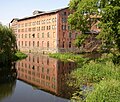 Bolbrüggesche Mühle viewed from the water
 -
 Pferdemarkt 5, the "Zwerchhaus"
 -
 Pferdemarkt 2
 -
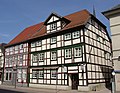 Building on the Große Straße
 -
 Kichenplatz


,_auf_dem_Kirchenplatz.JPG)
Twin towns
 Albertslund, Denmark
- Borken, Germany
 Whitstable, United Kingdom
 Říčany, Czech Republic
 Mölndal, Sweden
Notable people
.jpg)
Aristocracy

- Frederick, Duke of Mecklenburg-Grabow (1638-1688), resided in Grabow from 1669 until his death
- Adolphus Frederick II, Duke of the Mecklenburg-Strelitz (1658–1708), reigning duke of the Mecklenburg-Strelitz
- Karl Leopold, Duke of Mecklenburg-Schwerin (1678–1747), reigning duke in Mecklenburg-Schwerin
- Christian Ludwig II, Duke of Mecklenburg-Schwerin (1683–1756), reigning duke in Mecklenburg-Schwerin
- Sophia Louise of Mecklenburg-Schwerin (1685–1735), Queen of Prussia
- Louis, Hereditary Prince of Mecklenburg-Schwerin (1725–1778), hereditary prince of Mecklenburg-Schwerin
Arts

- The Mann family, a Hanseatic family is partially connected to Grabow
- Friedrich Lenthe (1774–1851), painter and lithographer
- Wilhelm Langschmidt (1805–1866), German-South African painter
- Carl Ludwig Theodor Graff (1844–1906), architect
- Gustav Hinrichs (1850–1942), German-American conductor and composer
- Martha Rose-Grabow (1858–1940), painter
- Wilhelmine Fleck (1864–1997), writer[85]
- Richard Havemann (1875–1943), animal tamer & trainer
- Gustav Ritter (1867–1945), factory owner and author
- Paul Sprenk (1898–1988), painter
- Katharina Brauren (1910–1998), actress
- Hermann Schepler (1911–1993), painter and graphic designer
- Volkwin Marg (born 1936), architect who partially lived in Grabow
Politics
- Franz Floerke (1811–1889), jurist and former mayor of Grabow (1839–1889)
- Karl Hahn (1858–1946), music teacher and botanist[86]
- Joseph Marcus (1886–1961), jurist and Zionist activist
- Willi Fründt (1909–1944), communist executed by the Nazis
- Bernhard Leverenz (1909–1987), jurist and politician (FDP)
- Alwin Ziel (born 1941), politician (SPD)
- Stefan Sternberg (born 1984), Landrat of Ludwigslust-Parchim since 2018 and former mayor of Grabow (2013–2018)
Science
- Heinrich Zander (1800–1976), ornithologist and pastor
- Otto Plath (1885–1940), German-American biologist
- Hans Havemann (1887–1985), writer, journalist, and geologist
- Wilhelm Jesse (1887–1971), teacher and historian
- Willy Havemann (1892–1969), medical practitioner and local historian[87]
- Oskar Kurz (1896–1945), local historian
- Helmut Pankow (1929–1996), botanist and university professor
Sports

- Bastian Reinhardt (born 1975), footballer, played at Empor Grabow, now assistant manager of VfB Lübeck
- Marco Küntzel (born 1976), footballer, played from 1981 to 1990 at Empor Grabow
Others
- Hermann Joachim Hahn (1679–1726), protestant theologian at the Dresden Kreuzkirche
- Carl Bolbrügge (1849–1898), owner of the Bolbrüggesche Mühle
- Hans Eberhard (1861–1940), judge
Notes
References
- ^ "Bevölkerungsstand der Kreise und Gemeinden 2024" (XLS) (in German). Statistisches Amt Mecklenburg-Vorpommern.
- ^ a b c d "Grabow". mecklenburg-vorpommern.volksbund.de (in German). Retrieved 2025-05-17.
- ^ "Grabow | Stadtkern". staedtebaufoerderung.info. 2024. Archived from the original on 2025-05-17. Retrieved 2025-05-17.
- ^ "Stadt Grabow ZWK". www.zukunftswerkstatt-kommunen.de (in German). 2024-08-21. Retrieved 2025-05-17.
- ^ a b "Vertrag über die Eingemeindung der Gemeinde Steesow zur Stadt Grabow". 2015-10-05. Archived from the original on 2015-12-21.
- ^ a b "Gemeinsam in eine neue Zukunft" (PDF). Grabower Amtsanzeiger. No. 1. 2016-01-08. pp. 6–7. Retrieved 2025-05-15.
- ^ a b c d "Die Stadt Grabow und die Bürgermeister/innen" (PDF). Grabower Amtsanzeiger. No. 12. 2020-12-04. p. 12. Retrieved 2025-05-15.
- ^ a b "Stadtgeschichte | Amt Grabow". www.grabow.de. Retrieved 2025-05-17.
- ^ a b c FLÄCHENNUTZUNGSPLAN DER STADT GRABOW (PDF) (in German). March 2006. p. 6.
- ^ a b "grabow". griesegegend-online.de. Retrieved 2025-05-15.
- ^ a b "Sammlung Online | Hamburger Kunsthalle". online-sammlung.hamburger-kunsthalle.de (in German). Retrieved 2025-10-30.
- ^ a b "Die Juden von Grabow". www.juden-in-mecklenburg.de. Retrieved 2025-05-17.
- ^ a b "Die Synagoge Grabow". www.juden-in-mecklenburg.de. Retrieved 2025-05-17.
- ^ a b "Jüdische Gemeinde - Grabow (Mecklenburg-Vorpommern)". www.xn--jdische-gemeinden-22b.de. Retrieved 2025-05-17.
- ^ "Jüdischer Friedhof Grabow". www.juden-in-mecklenburg.de. Retrieved 2025-05-17.
- ^ G. de Beer, A. Paterson, H. Olivier: 160 Years of Export. PPECB. Plattekloof, South Africa. 2003. ISBN 0-620-30967-9
- ^ "Franz Floerke" (PDF). grabow-erinnerungen.de. Archived from the original (PDF) on 17 November 2016. Retrieved 2025-12-19.
- ^ "Der Grabower Bürgermeister Geheimer Hofrat Dr. jur. Franz Floerke" (PDF). Grabower Amtsanzeiger. No. 12. 4 August 2023. p. 12. Retrieved 2025-12-19.
- ^ "Franz Floerke und Fritz Reuter". grabow-erinnerungen.de. Archived from the original on 7 July 2017. Retrieved 2025-12-19.
- ^ a b "Nazizeit" (PDF). grabow-erinnerungen.de. Archived from the original (PDF) on 2017-06-23. Retrieved 2025-05-17.
- ^ "Willi Fründt". grabow-erinnerungen.de. Archived from the original on 2021-06-20. Retrieved 2025-05-16.
- ^ a b Schulz-Naumann, Joachim (1990). Mecklenburg 1945 (in German) (2nd ed.). Munich: Universitas. pp. 270–272. ISBN 3-8004-1215-2.
- ^ "Russische Besatzung im Mai 1945 in Grabow" (PDF). Grabower Amtsanzeiger. No. 4. 2017-04-04. pp. 15/16. Retrieved 2025-12-19.
- ^ "Satzungsänderung der Verbandssatzung des Kommunalen Anteilseignerverbandes der WEMAG" (PDF). Amtsblatt für Brandenburg. 2024-12-22. p. 6.
- ^ "Das Amt | Amt Grabow". www.grabow.de. Retrieved 2025-05-17.
- ^ "Kreisreform in Mecklenburg-Vorpommern". Retrieved 2025-05-17.
- ^ Pohle, Mayk (2024-10-28). "Dieser Sommer hat das Leben in Grabow verändert". www.nordkurier.de (in German). Archived from the original on 2024-10-28. Retrieved 2025-05-17.
- ^ NDR (2024-10-28). Grabow: Summer of Pioneers - Ein Experiment geht zu Ende (in German). Retrieved 2025-05-17 – via www.ndr.de.
- ^ "Future Hamburg Talk meets Kathleen Bartels, Mayor of Grabow". Hamburg’s business portal. Retrieved 2025-05-17.
- ^ a b c "Ergebnisse des Zensus in MV - Grabow, Stadt_Amt Grabow.xlsx". www.laiv-mv.de. Retrieved 2025-05-17.
- ^ "Grabow (Ludwigslust-Parchim, Mecklenburg-Vorpommern, Deutschland) - Einwohnerzahlen, Grafiken, Karte, Lage, Wetter und Web-Informationen". www.citypopulation.de. Retrieved 2025-05-17.
- ^ a b Bevölkerung des Landkreises Ludwigslust-Parchim vom 9. Mai 2011 nach Gemeinden und demografischen Merkmalen (PDF) (in German). Statistische Amt Mecklenburg-Vorpommern. 2014. p. 39.
- ^ a b "Evangelisch - Lutherische Kirche Grabow" (in German). Archived from the original on 2024-09-23. Retrieved 2025-05-17.
- ^ a b e.V, Tourismusverband Mecklenburg-Vorpommern. "Stadtkirche St. Georg". Tourismusverband Mecklenburg-Vorpommern e.V. (in German). Retrieved 2025-05-17.
- ^ "Katholische Pfarrei Heilige Edith Stein". pfarrei-edith-stein.de. Retrieved 2025-05-17.
- ^ "Adventgemeinde Grabow". grabow.adventist.eu (in German). Archived from the original on 2018-04-30. Retrieved 2025-05-17.
- ^ "Bochin - Kirchenkreis Prignitz". kirchenkreis-prignitz.de. Retrieved 2025-05-17.
- ^ "Impressum | Amt Grabow". www.grabow.de. Retrieved 2025-05-15.
- ^ "Ergebnis". votemanager.kdo.de. Retrieved 2025-05-15.
- ^ "Ergebnis". votemanager.kdo.de. Retrieved 2025-11-06.
- ^ "Ergebnis". votemanager.kdo.de. Retrieved 2025-11-06.
- ^ "Endgültiges Ergebnis der Wahl der Gemeindevertretungen der kreisangehörigen Gemeinden nach Gemeinden". laiv-mv.de. 2014. Retrieved 2026-05-19.
- ^ Kommunalwahlen in Mecklenburg-Vorpommern am 7. Juni 2009. Statistische Hefte (in German). July 2010. pp. 65–69.
- ^ Kommunalwahlen in Mecklenburg-Vorpommern am 7. Juni 2009. Statistische Hefte (in German). July 2010. pp. 65–69.
- ^ "Stadtvertretung". stadtgrabow.de. 2004-06-13. Archived from the original on 2005-02-18. Retrieved 2025-11-06.
- ^ "Endgültiges Ergebnis der Wahl der Gemeindevertretungen in den kreisangehörigen Gemeinden nach Gemeinden". www.laiv-mv.de. Retrieved 2025-11-06.
- ^ "Endgültiges Ergebnis der Wahl der Gemeindevertretungen in den kreisangehörigen Gemeinden nach Gemeinden". www.laiv-mv.de. Retrieved 2025-11-06.
- ^ "Fünf-Prozent-Hürde". www.wahlrecht.de. Retrieved 2025-05-16.
- ^ "Bürgermeisterwahl der Stadt Grabow - Bürgermeisterwahl der Stadt Grabow 2018 Amt Grabow - Gesamtergebnis". votemanager.kdo.de. Archived from the original on 2025-05-15. Retrieved 2025-05-15.
- ^ a b NDR. "Grabow: Bürgermeisterin Kathleen Bartels bleibt im Amt". www.ndr.de (in German). Archived from the original on 2025-05-15. Retrieved 2025-05-15.
- ^ Pohle, Mayk (2025-05-11). "Kathleen Bartels gewinnt die Grabower Wahl und bleibt im Amt". www.nordkurier.de (in German). Archived from the original on 2025-05-12. Retrieved 2025-05-15.
- ^ "Rathaus – Karten klein" (PDF). politische-jugendbildung.blog. Retrieved 2025-05-16.
- ^ a b c "Grabow Subcounty (Germany)". www.crwflags.com. Retrieved 2025-05-15.
- ^ "Wappen von Grabow/Coat of arms (crest) of Grabow". Heraldry of the World. Archived from the original on 2025-03-22. Retrieved 2025-05-15.
- ^ "Hauptsatzung der Stadt Grabow – § 1 Name/Wappen/Flagge/Dienstsiegel" (PDF). 2020-08-12. Archived (PDF) from the original on 2024-12-09.
- ^ "Grabow- Bunte Stadt an der Elde | Amt Grabow". www.grabow.de. Retrieved 2025-05-17.
- ^ "Kinder- & Jugend | Amt Grabow". www.grabow.de. Retrieved 2025-05-17.
- ^ "Bibliothek | Amt Grabow". www.grabow.de. Archived from the original on 2025-08-14. Retrieved 2026-05-09.
- ^ Pohle, Mayk (2025-04-09). "Grabows Eldekinder haben jetzt ihren eigenen Leseclub". www.nordkurier.de (in German). Archived from the original on 2025-04-18. Retrieved 2025-05-17.
- ^ Sonnemann. "Realprogymnasium, 1868 - 1924". grabow-erinnerungen.de. Archived from the original on 2016-11-15. Retrieved 2026-05-09.
- ^ Kleemann, Harald (2020-11-06). "150 Jahre Reuter-Haus Grabow am Kießerdamm" (PDF). Grabower Amtsanzeiger. No. 11. p. 13. Retrieved 2026-05-09.
- ^ GmbH, MV Tourismus. "Bolbrüggesche Mühle - Wassermühle Grabow". MV Tourismus GmbH (in German). Retrieved 2026-05-09.
- ^ Zänger, Horst (2002). Wasserparadies Mecklenburg (in German). Schwerin. pp. 48–49. ISBN 3-8311-3965-2.
{{cite book}}: CS1 maint: location missing publisher (link) - ^ "Wassermühle in Grabow die Mühle Bolbrügge bei Ludwigslust in Mecklenburg - Vorpommern". zwillingswindmuehlen.de. Retrieved 2026-05-09.
- ^ Madus, pp. 20
- ^ Madus, pp. 20–23
- ^ NDR. "Grabows beschädigtes Rathaus: In der Altstadt galt ein Böllerverbot" (in German). Archived from the original on 2023-01-02. Retrieved 2026-05-09.
- ^ Madus, pp. 21–22
- ^ Madus, pp. 22–23
- ^ Madus, pp. 40–41
- ^ Madus, p. 46
- ^ Madus, pp. 43–45
- ^ "Orgelmuseum Malchow". www.orgelmuseum-malchow.de. Archived from the original on 2021-04-13. Retrieved 2026-05-09.
- ^ "Museum Grabow | Amt Grabow". www.grabow.de. Retrieved 2025-05-17.
- ^ Zimmermann, Juana (2024-06-23). "Grabow gewinnt Stadtaufgabe mit Küsschen". www.nordkurier.de (in German). Archived from the original on 2024-06-24. Retrieved 2025-05-17.
- ^ "Museum Grabow". metropolregion.hamburg.de. Retrieved 2025-05-17.
- ^ "Grabow: Volkseigene Betriebe VEB in der DDR". www.mil-airfields.de (in German). Retrieved 2025-05-17.
- ^ "Continental Bakeries übernimmt Grabower". backwelt.de. 2010-04-29. Archived from the original on 2019-08-01. Retrieved 2025-05-17.
- ^ "Europe's Top Private Label Biscuit Manufacturer | Biscuit International". biscuitinternational.com. Retrieved 2025-05-17.
- ^ Pohle, Mayk (2025-03-25). "Grabow begrüßt mit dem Lichterfest den Frühling". www.nordkurier.de (in German). Archived from the original on 2025-05-17. Retrieved 2025-05-17.
- ^ "Besondere Events | Amt Grabow". www.grabow.de (in German). Archived from the original on 2025-04-21. Retrieved 2025-08-10.
- ^ "Impressum". Stadtkieker-Grabow.de (in German). 2025-05-02. Retrieved 2025-05-17.
- ^ Ramünke-Hoefer, Maren (2024-08-24). "Schweriner Winzerfest diesmal mit einem Extra-Tag". www.nordkurier.de (in German). Archived from the original on 2024-10-07. Retrieved 2025-05-17.
- ^ "Städtepartnerschaft | Amt Grabow". www.grabow.de. Retrieved 2025-05-15.
- ^ Verlag, STRANDLÄUFER. "Strandläufer Verlag » Neuigkeiten". xn--strandlufer-verlag-rtb.de (in German). Archived from the original on 2021-08-01. Retrieved 2026-02-08.
- ^ Mensing, Petra (2017). Leben und Werk des Karl Hahn – 1858 bis 1946 – Archiv Natur- und Landeskunde Mecklenburg-Vorpommern (PDF) (54 ed.). GEOZON SCIENCE MEDIA. ISSN 0518-3189.
- ^ Sonnemann. "Kriegerdenkmale". www.grabow-erinnerungen.de. Archived from the original on 2023-03-30. Retrieved 2026-02-08.
Bibliography
- Madus, Christian (1999). Grabow. Geschichte und Gegenwart (2nd ed.). Schwerin: Stock & Stein. ISBN 978-3-932370-49-6
External links

- Official website (in German)
| Town and seat | | |
|---|---|---|
| Villages | ||
| Settlements | ||

| International | |
|---|---|
| National | |
| Geographic | |
| Other | |
